
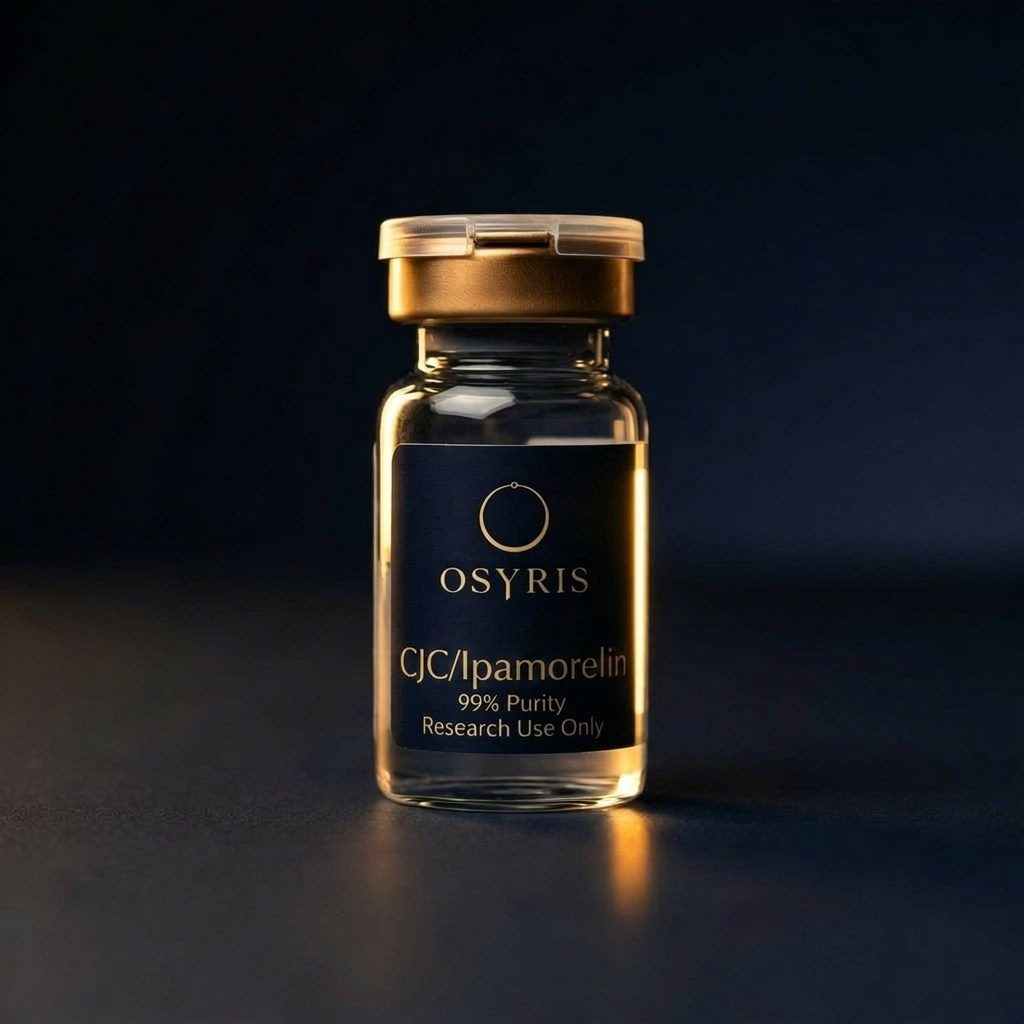
Growth Hormone
CJC NO DAC/Ipamorelin Blend
This blend combines CJC-1295 (No DAC) and Ipamorelin—two research peptides that act synergistically on the growth hormone (GH) axis. CJC-1295 stimulates GH-releasing hormone (GHRH) receptors, while Ipamorelin targets ghrelin receptors. Their combined use supports investigation into pulsatile GH secretion and downstream effects in cellular and endocrine research models.
- Quantity
- 10mg
- Purity
- See COA
Standard $9.99 | Expedited $12.99 | Free standard over $200
Download Certificate of AnalysisResearch overview
Product Overview:
Product Name: CJC-1295 (No DAC) / Ipamorelin Blend
Quantity: 10mg
Molecular Formula (CJC-1295 No DAC): C152H252N44O42
Molecular Formula (Ipamorelin): C38H49N9O5
Research Use Only. Not for Human Consumption.
Research Applications:
-
Synergistic Growth Hormone Release Models
CJC-1295 (No DAC) is a modified GHRH analog that selectively binds GHRH receptors to stimulate endogenous growth hormone secretion. Without the DAC (Drug Affinity Complex), its half-life is shorter (~30 minutes), mimicking physiological GH pulse release more closely. Ipamorelin is a selective ghrelin receptor agonist (GHSR-1a) that promotes GH release with minimal impact on cortisol or prolactin levels [1][2].
Together, these peptides stimulate the pituitary through distinct mechanisms—GHRH and ghrelin receptor pathways—resulting in enhanced GH output in pulsatile patterns. This makes them of interest in studies focused on hormone secretion regulation and receptor-specific activation.
-
Endocrine Signaling and Pituitary Axis Studies
Research in rodent and in vitro models has shown that CJC-1295 (No DAC) enhances GH secretion without altering ACTH, prolactin, or TSH levels. Ipamorelin’s receptor specificity further allows researchers to study GH release without undesired stimulation of appetite or adrenal hormones, which is commonly observed with other ghrelin mimetics like GHRP-6 [3].
This blend is particularly useful for examining the GH/IGF-1 axis, hypothalamic-pituitary feedback mechanisms, and dose-response relationships in pulsatile hormone release studies.
-
Pharmacokinetics and GH Pulse Frequency
CJC-1295 No DAC has a short duration of action that makes it suitable for studying the natural pulsatility of GH secretion. In contrast, long-acting analogs may suppress natural GH rhythms. When paired with Ipamorelin, the release of GH is amplified but still remains physiologically pulsatile, a feature important for evaluating feedback regulation in endocrine systems [4].
Studies using GH-reporter cell lines or transgenic mice models have leveraged this combination to monitor dynamic responses in GH levels and downstream IGF-1 expression.
-
Muscle, Metabolic, and Recovery Models
While not therapeutic, the blend is commonly used in preclinical investigations on myogenesis, metabolism, and recovery signaling. GH pulses influence various cellular processes including glucose regulation, protein synthesis, and mitochondrial function. Researchers use this combination to explore GH-dependent mechanisms of repair and regeneration in muscle, bone, and metabolic models [5].