
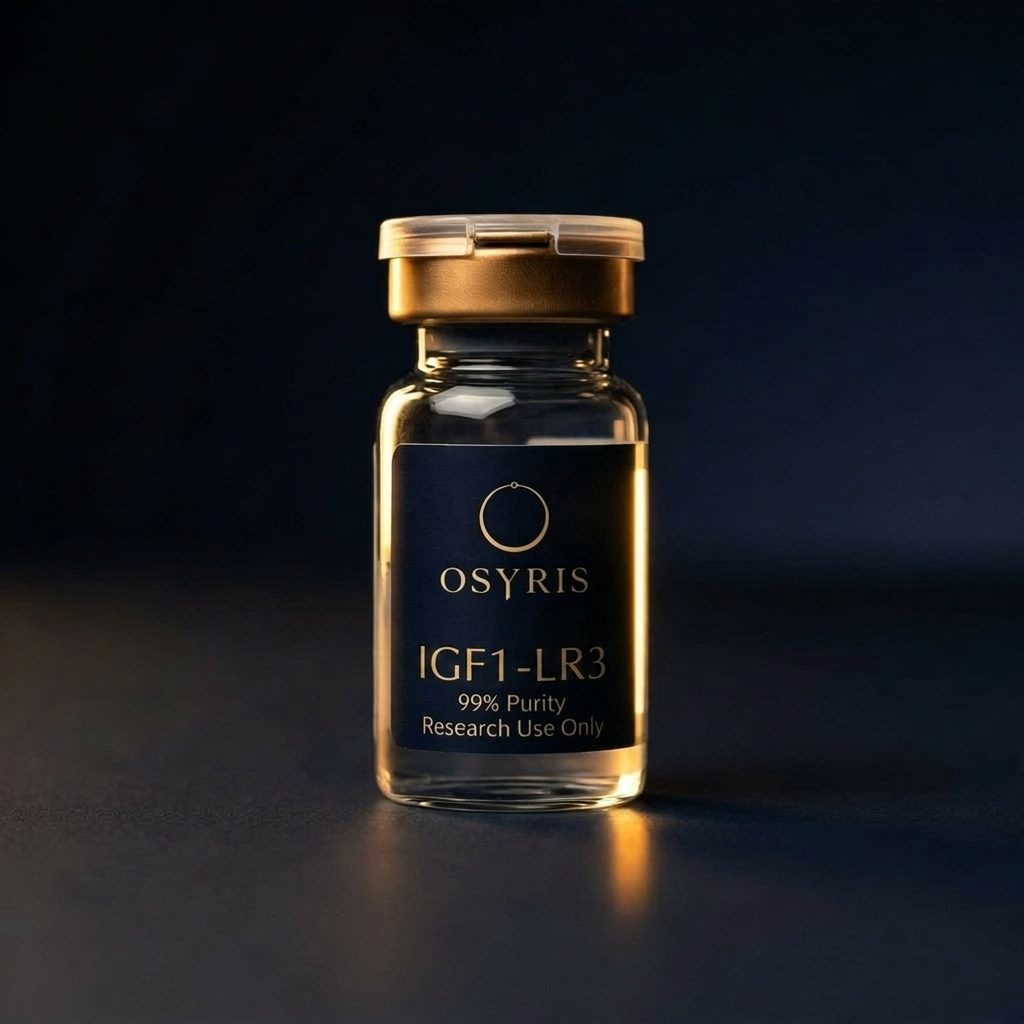
IGF1-LR3's reduced IGFBP binding makes it a cleaner research tool than native IGF-1 for studying IGF-1 receptor (IGF-1R) biology. In cell culture, native IGF-1 is substantially sequestered by IGFBPs in the media, making it difficult to control effective concentrations. IGF1-LR3 remains largely free, providing more predictable dose-response relationships.1

IGF1-LR3
IGF-1 LR3 is an 83-amino-acid recombinant analog of insulin-like growth factor-1 with an N-terminal extension and Arg3 substitution. It is used to study IGF-1 receptor signaling, proliferation, differentiation, and survival pathways in cell culture and animal models.
Product Overview
IGF1-LR3 (Insulin-like Growth Factor 1, Long R3 variant) is a modified version of human IGF-1 — a 70-amino-acid protein that mediates many of growth hormone's biological effects. The "Long R3" modification involves an arginine-to-glutamate substitution at position 3 and an N-terminal extension of 13 amino acids. These modifications dramatically reduce IGF1-LR3's binding to IGF-binding proteins (IGFBPs), resulting in greater bioavailability and potency compared to native IGF-1 in cell culture systems.
IGF-1 sits downstream of growth hormone in the somatotropic axis: GH stimulates the liver to produce IGF-1, which then mediates cell proliferation, differentiation, and survival in target tissues. IGF1-LR3 allows researchers to study IGF-1 receptor biology directly without the confounding variable of IGFBP sequestration.

Mechanism and Experimental Context
IGF1-LR3 is widely used as a growth factor supplement in cell culture media, where it promotes the proliferation and survival of various cell types. It is a standard component of serum-free media formulations for stem cell culture, primary cell culture, and hybridoma maintenance.2
As the downstream effector of growth hormone signaling, IGF1-LR3 allows researchers to study GH-mediated effects at the IGF-1 receptor level independently from GH receptor activation, somatostatin regulation, and other upstream variables in the somatotropic axis.3
Keep the Research Trail Moving
Source Literature
Francis GL, et al. "Insulin-like growth factor 1 analogue with enhanced biological potency." Journal of Molecular Endocrinology, 1992.
Pollard JW. "Growth factors in cell culture." Methods in Molecular Biology, 1997.
Clemmons DR. "Role of IGF-binding proteins in regulating IGF responses to changes in metabolism." Journal of Molecular Endocrinology, 2018.
Batch Documentation
Current published batch documentation is surfaced on-page whenever the provider exposes a public COA asset.

Frequently Asked Questions
Questions About IGF1-LR3
A modified version of human IGF-1 with reduced binding to IGF-binding proteins, resulting in greater bioavailability in research models. Used extensively in cell culture as a growth factor.
It refers to two modifications: an arginine-to-glutamate substitution at position 3, and an N-terminal extension of 13 amino acids. Together, these reduce IGFBP binding by approximately 100-fold.
IGF-1 is the downstream effector of GH — the liver produces IGF-1 in response to GH stimulation. IGF1-LR3 allows researchers to study IGF-1 receptor effects directly, bypassing the GH-to-IGF-1 production step.
No. Research compound for laboratory use only.
Lyophilized at -20°C. Very temperature-sensitive — maintain cold chain.
Independently tested via HPLC and LC-MS. COA downloadable on this page.
It's a modified version. Native IGF-1 is heavily bound by IGF-binding proteins in biological media. IGF1-LR3 escapes this binding, making it more potent and predictable in cell culture research.
Because it's the downstream effector of GH signaling. It belongs in the same axis as the GH secretagogues (Ipamorelin, Sermorelin, Tesamorelin, CJC-1295) that stimulate its upstream production.
Every Batch Tested by an Independent Lab
We publish the Certificate of Analysis for every product. See our full testing process.