
AboutStandards
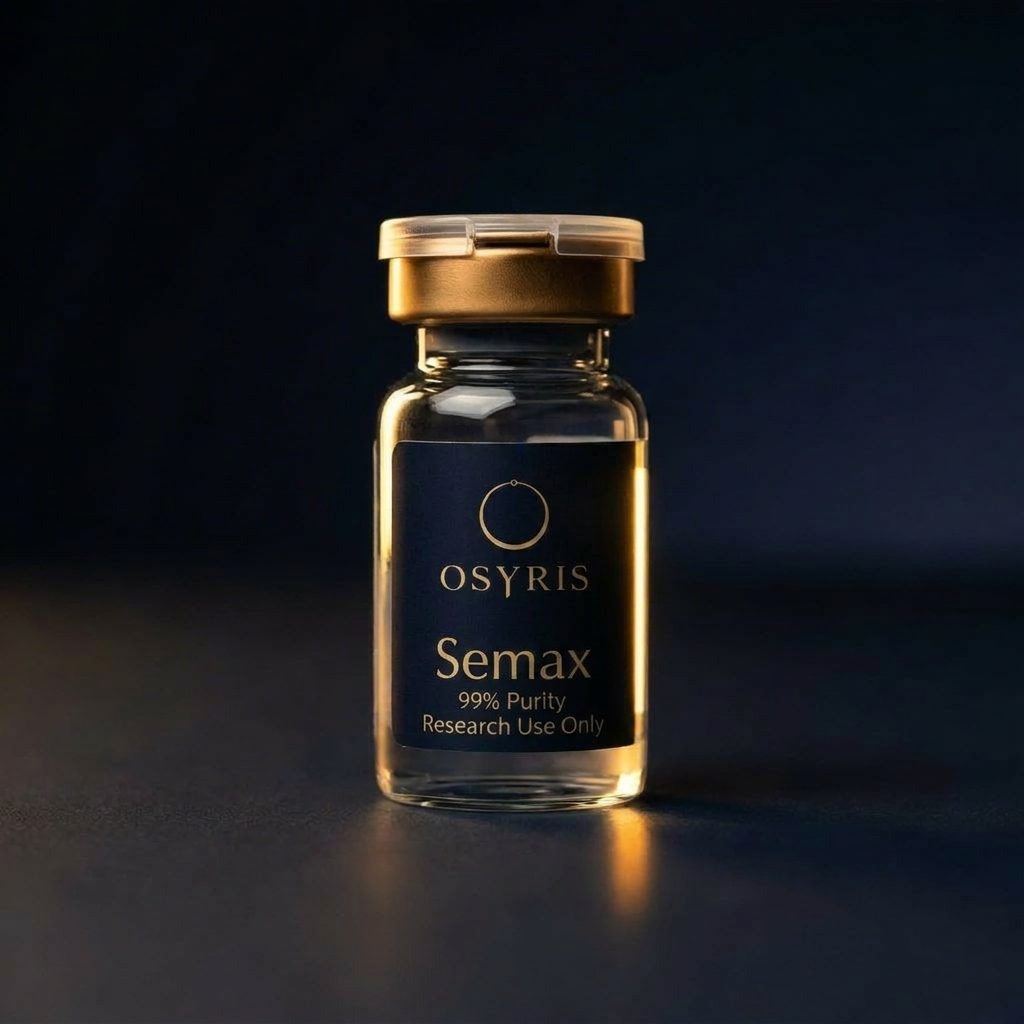
Semax research peptide vial — OSYRIS Health
COGNITIVE

Semax

$39.99

Semax is a synthetic heptapeptide (Met-Glu-His-Phe-Pro-Gly-Pro) derived from the ACTH(4–10) fragment of adrenocorticotropic hormone. It is widely used in neuroscience and pharmacological research for its ability to modulate brain-derived neurotrophic factor (BDNF), melanocortin receptors, and various neurotransmitter systems. Supplied as a lyophilized powder, Semax is intended strictly for laboratory research use only.

QuantityStandard research vial
PuritySee COA
Free shipping on orders over $200
Download Certificate of Analysis
About This Compound

Product Overview

Semax is a synthetic heptapeptide (seven amino acids) based on the N-terminal fragment of adrenocorticotropic hormone (ACTH 4-10). It was developed in the 1980s at the Institute of Molecular Genetics of the Russian Academy of Sciences as part of a program to create neuroprotective peptides derived from endogenous hormones. The design principle was to retain the neurotrophic properties of ACTH while removing its hormonal (adrenal) activity.

The resulting compound — with the sequence Met-Glu-His-Phe-Pro-Gly-Pro — has been one of the most studied nootropic peptides in the Russian scientific literature, with a research history spanning four decades. Semax has been approved as a prescription medication in Russia for certain neurological indications, though it has no regulatory approval in the United States or European Union.

What makes Semax particularly interesting to researchers is its effect on neurotrophic factor expression — specifically, its ability to upregulate BDNF (brain-derived neurotrophic factor) and NGF (nerve growth factor) in various brain regions. This neurotrophic mechanism differentiates Semax from most nootropic compounds, which typically work through receptor modulation or neurotransmitter metabolism.

Semax neurotrophic factor and BDNF signaling research visualization — OSYRIS Health
Research Applications

Mechanism and Experimental Context

Semax's most significant research finding is its effect on neurotrophic factor expression. BDNF and NGF are proteins that support the survival, growth, and differentiation of neurons. They play critical roles in neuroplasticity — the brain's ability to form new connections and adapt. BDNF in particular has been called "fertilizer for the brain" by researchers due to its role in supporting synaptic plasticity and memory formation.1

Studies in rat models have demonstrated that Semax administration significantly increases BDNF mRNA expression in the hippocampus, frontal cortex, and basal forebrain. A 2007 study by Dolotov et al. showed that a single administration of Semax produced elevated BDNF levels in the hippocampus that persisted for 24 hours.2 Similar effects on NGF expression have been documented in the same brain regions.

The neurotrophic mechanism is considered Semax's primary mode of action, distinguishing it from stimulant-type nootropics that work through catecholamine pathways.

Semax has been studied in animal models of brain injury and neurodegeneration. In rat models of cerebral ischemia (stroke), Semax treatment administered post-injury reduced infarct volume and improved functional outcomes. The neuroprotective effect was associated with reduced oxidative stress markers and increased expression of anti-apoptotic factors in the affected brain tissue.3

Research in rat models of transient global brain ischemia showed that Semax treatment preserved hippocampal CA1 neurons — a brain region that is particularly vulnerable to ischemic damage and plays a critical role in memory formation.

The neuroprotective research is interpreted in the context of Semax's neurotrophic effects: by upregulating BDNF and NGF, the peptide may create a more resilient neural environment that resists injury-induced cell death.

A series of studies have investigated Semax's effects on gene expression in brain tissue using microarray analysis. Research by Agapova et al. found that Semax modulated the expression of genes involved in immune response, vascular function, and cell survival pathways in rat brain tissue following ischemic injury.4

The breadth of gene expression changes suggests that Semax's effects extend beyond direct neurotrophic factor upregulation to include broader neuroprotective and anti-inflammatory transcriptional programs.

An unexpected finding in Semax research has been its immunomodulatory effects. Studies have shown that Semax can influence the expression of genes involved in immune cell function, including cytokine production and immune cell activation. This research has led to investigation of Semax in models where neuroinflammation plays a pathological role.5

Selank, a related peptide also available in the OSYRIS catalog, was specifically developed for immunomodulatory and anxiolytic research applications, partly based on these immune-related findings from Semax studies.

Referenced Studies

Source Literature

[1]

Binder DK, Scharfman HE. "Brain-derived neurotrophic factor." Growth Factors, 2004. PubMed: PMID 15518235

[2]

Dolotov OV, et al. "Semax, an analogue of ACTH(4-10) with cognitive effects, regulates BDNF and trkB expression in the rat hippocampus." Brain Research, 2006. PubMed: PMID 16469301

[3]

Gusev EI, et al. "Neuroprotective effects of Semax in acute cerebral ischemia." Zhurnal Nevrologii i Psikhiatrii, 1997. PubMed: PMID 9463034

[4]

Agapova TY, et al. "Semax influences the expression of genes related to the immune and vascular systems in rat brain focal ischemia." BMC Genomics, 2014.

[5]

Medvedeva EV, et al. "The peptide semax affects the expression of genes related to the immune and vascular systems in rat brain focal ischemia." Doklady Biological Sciences, 2013.

Certificate of Analysis

Batch Documentation

Current published batch documentation is surfaced on-page whenever the provider exposes a public COA asset.

Semax certificate of analysis

Frequently Asked Questions

Questions About Semax

Semax is a synthetic heptapeptide derived from the N-terminal fragment of ACTH (adrenocorticotropic hormone). It was designed to retain the neurotrophic properties of ACTH while eliminating its hormonal effects on the adrenal glands. It is studied primarily for its effects on neurotrophic factor expression (BDNF, NGF) in brain tissue.

BDNF (brain-derived neurotrophic factor) is a protein that supports the survival, growth, and differentiation of neurons. It plays a key role in neuroplasticity — the brain's ability to form new synaptic connections. Low BDNF levels have been associated with various neurological conditions in observational studies.

Both are Russian-developed nootropic peptides, but they come from different parent molecules and have different research profiles. Semax is derived from ACTH and primarily studied for neurotrophic factor upregulation. Selank is derived from tuftsin (an immune peptide) and primarily studied for anxiolytic and immunomodulatory effects. They are sometimes studied together in research protocols.

Semax is approved as a prescription medication in Russia for certain neurological indications. It does not have regulatory approval in the United States, European Union, or most other countries. OSYRIS Semax is a research-grade compound sold exclusively for laboratory research.

Most stimulant-type nootropics work by modulating neurotransmitter levels (dopamine, norepinephrine, acetylcholine). Semax works through a fundamentally different mechanism — it upregulates neurotrophic factors (BDNF, NGF) that support neuronal growth and plasticity. This distinction makes it useful as a research tool for studying neurotrophic pathways independently from neurotransmitter systems.

Store lyophilized Semax at 2-8°C for short-term use or -20°C for long-term storage. Protect from light and moisture. Semax is relatively stable in lyophilized form. Once reconstituted, refrigerate and use promptly.

Every batch is independently tested using HPLC and LC-MS analysis. The Certificate of Analysis is downloadable on this page.

Semax is a heptapeptide with the sequence Met-Glu-His-Phe-Pro-Gly-Pro. It corresponds to the 4-10 fragment of ACTH with a C-terminal Pro-Gly-Pro extension that improves metabolic stability.

Every Batch Tested by an Independent Lab

We publish the Certificate of Analysis for every product. See our full testing process.

See Our Standards →

All products sold by OSYRIS Health are intended for laboratory research purposes only and are not for human or veterinary use. The information provided on this page describes published scientific research and does not constitute medical advice, diagnosis guidance, or a recommendation for any specific use. Always ensure compliance with local regulations.