
AboutStandards
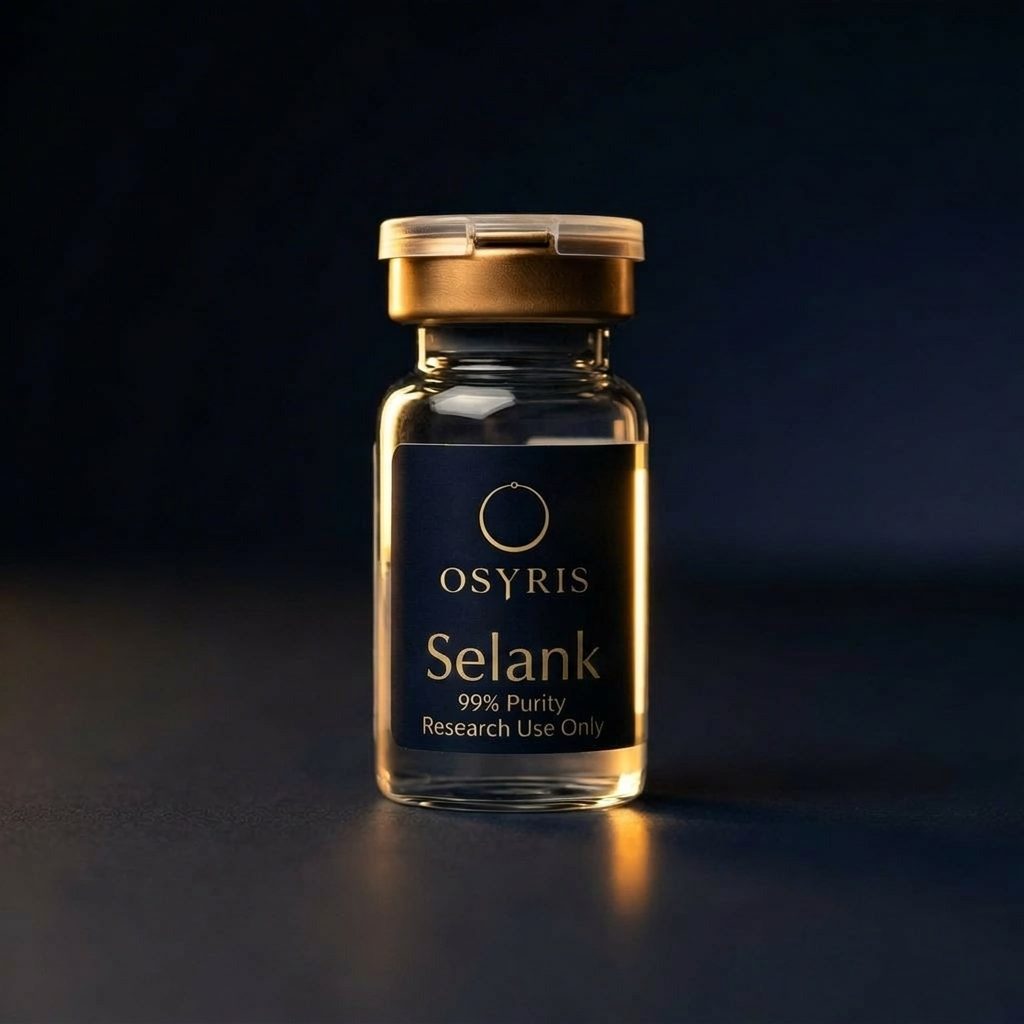
Selank research peptide vial — OSYRIS Health
COGNITIVE

Selank

$39.99

Selank is a synthetic heptapeptide with the amino acid sequence Thr-Lys-Pro-Arg-Pro-Gly-Pro. Structurally derived from the endogenous tetrapeptide tuftsin, Selank is classified as an anxiolytic and neuroregulatory research peptide. It has been widely studied for its impact on monoamine neurotransmitters, immune modulation, and neurotrophic factors. Supplied as a lyophilized powder, Selank is intended strictly for in vitro and in vivo research applications.

QuantityStandard research vial
PuritySee COA
Free shipping on orders over $200
Download Certificate of Analysis
About This Compound

Product Overview

Selank is a synthetic heptapeptide developed at the Institute of Molecular Genetics of the Russian Academy of Sciences — the same laboratory that created Semax. While Semax was derived from ACTH, Selank was derived from tuftsin, a naturally occurring immunostimulatory tetrapeptide (Thr-Lys-Pro-Arg) produced by enzymatic cleavage of the heavy chain of immunoglobulin G (IgG).

Selank's sequence — Thr-Lys-Pro-Arg-Pro-Gly-Pro — consists of tuftsin plus a C-terminal Pro-Gly-Pro extension identical to the one used in Semax. This extension was added to improve the peptide's metabolic stability and prolong its biological activity in experimental models.

The dual nature of Selank's parent molecule is reflected in its research profile: it is studied both for anxiolytic (anxiety-modulating) effects and for immunomodulatory effects. This makes Selank unusual among nootropic peptides — most are studied for either neurological or immune effects, not both.

Selank GABA receptor modulation and anxiolytic research visualization — OSYRIS Health
Research Applications

Mechanism and Experimental Context

Selank's most studied property is its anxiolytic-like effect in animal behavioral models. Studies in rats using the elevated plus maze, open field test, and conflict test paradigms have consistently shown that Selank treatment reduces anxiety-like behavior without producing the sedation or motor impairment associated with benzodiazepine anxiolytics.1

The anxiolytic mechanism is thought to involve modulation of the GABAergic system — the brain's primary inhibitory neurotransmitter system. Research has shown that Selank influences the expression of GABA-A receptor subunit genes in the hippocampus and amygdala, potentially enhancing inhibitory neurotransmission in brain regions involved in anxiety processing.2

A key finding in the behavioral research is that Selank's anxiolytic effect occurs without the tolerance, dependence, or withdrawal phenomena associated with benzodiazepines in animal models. This pharmacological profile has generated interest in Selank as a research tool for studying non-benzodiazepine anxiolytic mechanisms.

Selank's derivation from tuftsin — an immune peptide — gives it a second research dimension. Studies have shown that Selank modulates the expression of cytokine genes in immune cells, influencing both pro-inflammatory and anti-inflammatory pathways. In vitro research demonstrated that Selank treatment altered the expression of IL-6, TNF-alpha, and other cytokines in human blood cell cultures.3

The immunomodulatory effects are thought to operate through mechanisms distinct from the anxiolytic effects. Tuftsin itself is known to activate monocytes and natural killer cells, and Selank appears to retain some of this immune-modulating capacity while adding the neurotropic effects conferred by the Pro-Gly-Pro extension.

This dual action — neurological and immunological — makes Selank a valuable research tool for studying the intersection of the nervous and immune systems, sometimes called neuroimmunology.

Beyond its GABAergic effects, Selank has been studied for its influence on monoamine neurotransmitter systems. Research in rat brain tissue has shown that Selank treatment modulates serotonin (5-HT) metabolism, particularly in brain regions associated with emotional regulation. Studies demonstrated changes in serotonin turnover in the hypothalamus and frontal cortex following Selank administration.4

The serotonergic effects, combined with the GABAergic modulation, suggest that Selank may influence multiple neurotransmitter systems relevant to anxiety and mood regulation — a broader pharmacological profile than compounds targeting a single receptor system.

Transcriptomic studies using microarray analysis have shown that Selank influences the expression of a broad range of genes in rat brain tissue. Research identified changes in genes related to GABAergic and glutamatergic neurotransmission, neurotrophic factor signaling, ion channel function, and immune response.5

The gene expression data provides a molecular-level complement to the behavioral research, showing that Selank's effects correspond to measurable transcriptional changes in brain regions relevant to anxiety processing.

Referenced Studies

Source Literature

[1]

Seredenin SB, et al. "Anxiolytic-like effect of Selank." Bulletin of Experimental Biology and Medicine, 2006. PubMed: PMID 17369724

[2]

Skrebitsky VG, et al. "Effect of Selank on GABA-A receptor subunit gene expression." Doklady Biological Sciences, 2010.

[3]

Ershov FI, et al. "Effects of Selank on cytokine gene expression." Immunologiya, 2009.

[4]

Narkevich VB, et al. "Effects of Selank on serotonin metabolism in rat brain." Bulletin of Experimental Biology and Medicine, 2008. PubMed: PMID 19489028

[5]

Zolotarev YA, et al. "Selank influence on gene expression of GABA, serotonin, dopamine receptors and neuropeptides in rat hippocampus." Pharmacology Biochemistry and Behavior, 2019.

Certificate of Analysis

Batch Documentation

Current published batch documentation is surfaced on-page whenever the provider exposes a public COA asset.

Selank certificate of analysis

Frequently Asked Questions

Questions About Selank

Selank is a synthetic heptapeptide derived from tuftsin, a naturally occurring immune peptide. It was developed at the same Russian laboratory that created Semax. Selank is studied for both anxiolytic (anxiety-modulating) and immunomodulatory effects — an unusual dual profile among research peptides.

Tuftsin is a natural tetrapeptide (Thr-Lys-Pro-Arg) produced by enzymatic cleavage of immunoglobulin G (IgG). It was discovered in the 1970s and is known to activate monocytes and natural killer cells. Selank is based on tuftsin's sequence with an added Pro-Gly-Pro extension for improved stability.

They come from different parent molecules and have different research focuses. Semax (from ACTH) is primarily studied for neurotrophic factor upregulation — enhancing BDNF and NGF expression. Selank (from tuftsin) is primarily studied for anxiolytic effects via GABA modulation and for immunomodulatory effects. Semax is more "activating" in research models; Selank is more "calming."

Both affect the GABA system, but through different mechanisms. Benzodiazepines directly bind to GABA-A receptors and enhance their activity. Selank appears to modulate GABA-A receptor subunit gene expression rather than directly binding the receptor. In animal models, Selank produced anxiolytic-like effects without the sedation, tolerance, or dependence associated with benzodiazepines.

Selank has been approved as a nasal spray medication in Russia for certain indications. It does not have regulatory approval in the United States or European Union. OSYRIS Selank is a research-grade compound sold exclusively for laboratory research.

Because its parent molecule (tuftsin) is an immune peptide. Selank retains some of tuftsin's immunomodulatory properties while gaining neurological effects from its structural modifications. This makes it useful for studying neuroimmunology — the intersection of the nervous and immune systems.

Store lyophilized Selank at 2-8°C for short-term use or -20°C for long-term storage. Protect from light and moisture. Once reconstituted, refrigerate and use promptly.

Every batch is independently tested using HPLC and LC-MS analysis. The Certificate of Analysis is downloadable on this page.

Every Batch Tested by an Independent Lab

We publish the Certificate of Analysis for every product. See our full testing process.

See Our Standards →

All products sold by OSYRIS Health are intended for laboratory research purposes only and are not for human or veterinary use. The information provided on this page describes published scientific research and does not constitute medical advice, diagnosis guidance, or a recommendation for any specific use. Always ensure compliance with local regulations.