
AboutStandards
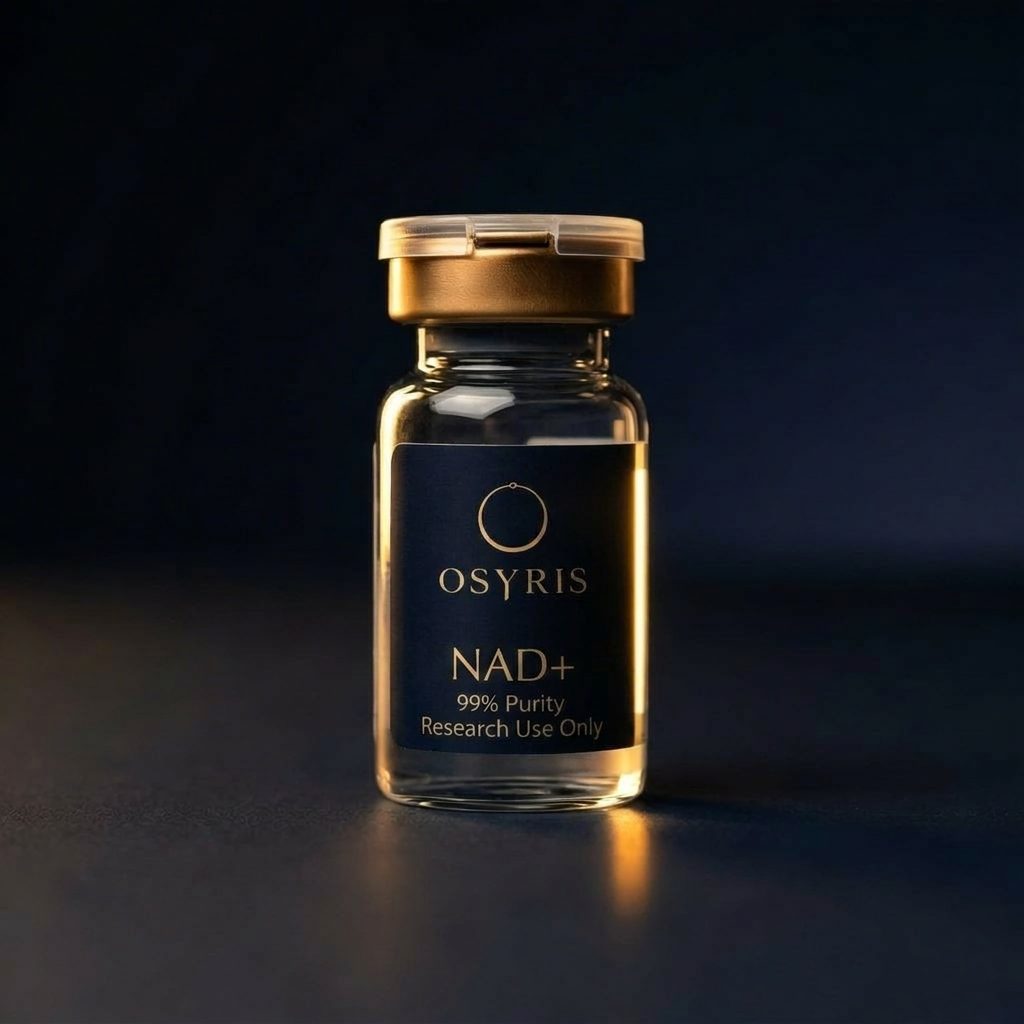
NAD+ research peptide vial — OSYRIS Health
LONGEVITY

NAD+

$74.99

NAD⁺ is a coenzyme present in all living cells, playing a central role in redox reactions, energy metabolism, DNA repair, and cellular signaling. This high-purity NAD⁺ solution is designed for laboratory research involving aging, mitochondrial function, and sirtuin activation pathways.

Quantity500mg
FormulaC21H27N7O14P2
Mol. Weight663.43 g/mol
PuritySee COA
Free shipping on orders over $200
Download Certificate of Analysis
About This Compound

Product Overview

NAD+ (nicotinamide adenine dinucleotide) is a coenzyme found in every living cell. It plays a central role in cellular energy metabolism, serving as an electron carrier in the mitochondrial reactions that convert nutrients into ATP — the cell's primary energy currency. Beyond energy production, NAD+ functions as a substrate for several families of enzymes involved in DNA repair, gene expression regulation, and cellular signaling.

Research interest in NAD+ has grown dramatically over the past decade, driven by the observation that NAD+ levels decline with age across multiple tissue types. This age-related decline has been documented in animal models and in human tissue samples, and it has become a central focus of aging biology research. The question driving much of the current investigation is whether restoring NAD+ levels in aged tissues can reverse or slow age-related functional decline.

OSYRIS NAD+ is supplied at 500mg in solution form, distinct from the lyophilized powder used for most peptide products. Its molecular weight is 663.43 g/mol with a molecular formula of C₂₁H₂₇N₇O₁₄P₂.

NAD+ cellular energy metabolism research visualization — OSYRIS Health
Research Applications

Mechanism and Experimental Context

NAD+ serves as a required co-substrate for the sirtuin family of enzymes (SIRT1-7), which regulate gene expression, DNA repair, and mitochondrial function. Sirtuins cannot function without NAD+ — as NAD+ levels decline with age, sirtuin activity decreases proportionally. This relationship has made NAD+ a focal point of aging biology research.1

Studies in aging mouse models have shown that boosting NAD+ levels through supplementation with precursors (NMN and NR) restored sirtuin activity and improved markers of metabolic health, mitochondrial function, and DNA repair in aged tissues. A landmark 2013 study by Gomes et al. in Cell demonstrated that raising NAD+ levels in aged mice restored mitochondrial function in skeletal muscle to levels comparable to young mice.2

NAD+ is consumed by PARP enzymes (poly-ADP-ribose polymerases) during DNA repair. When cells experience DNA damage — from oxidative stress, radiation, or metabolic byproducts — PARP enzymes use NAD+ to build repair scaffolds at the damage site. In cells with low NAD+ levels, DNA repair is impaired, which can lead to genomic instability.3

Research has explored whether NAD+ depletion contributes to the accumulation of DNA damage observed in aging cells, and whether NAD+ repletion can restore repair capacity. Studies in mouse models of accelerated aging (such as the xeroderma pigmentosum model) have shown that NAD+ supplementation improved DNA repair and extended healthy lifespan.4

NAD+ is an essential cofactor in the citric acid cycle and oxidative phosphorylation — the central metabolic pathways that produce cellular energy. As NAD+ levels decline in aging tissues, mitochondrial efficiency decreases, leading to reduced ATP output and increased production of reactive oxygen species.

Research in aged mouse models has demonstrated that NAD+ repletion improves mitochondrial membrane potential, increases respiratory chain complex activity, and restores oxidative phosphorylation capacity in tissues including muscle, liver, and brain.5

NAD+ metabolism has been investigated in models of neurodegenerative disease. Research in animal models of Alzheimer's disease, Parkinson's disease, and age-related cognitive decline has explored whether NAD+ supplementation can protect neurons from metabolic and oxidative stress.

A 2020 study in mouse models of Alzheimer's disease showed that NMN supplementation (which raises NAD+ levels) reduced amyloid-beta accumulation, decreased neuroinflammation, and improved cognitive function in behavioral tests.6

Referenced Studies

Source Literature

[1]

Imai S, Guarente L. "NAD+ and sirtuins in aging and disease." Trends in Cell Biology, 2014. PubMed: PMID 25263697

[2]

Gomes AP, et al. "Declining NAD+ induces a pseudohypoxic state disrupting nuclear-mitochondrial communication during aging." Cell, 2013. PubMed: PMID 24360282

[3]

Fang EF, et al. "NAD+ replenishment improves lifespan and healthspan in ataxia telangiectasia models via mitophagy and DNA repair." Cell Metabolism, 2016. PubMed: PMID 26869999

[4]

Fang EF, et al. "NAD+ augmentation restores mitophagy and limits accelerated aging in Werner syndrome." Nature Communications, 2019. PubMed: PMID 31780669

[5]

Zhang H, et al. "NAD+ repletion improves mitochondrial and stem cell function and enhances life span in mice." Science, 2016. PubMed: PMID 27127236

[6]

Yao Z, et al. "Nicotinamide mononucleotide inhibits JNK activation to reverse Alzheimer disease." Neuroscience Letters, 2017. PubMed: PMID 28330719

Certificate of Analysis

Batch Documentation

Current published batch documentation is surfaced on-page whenever the provider exposes a public COA asset.

NAD+ certificate of analysis

Frequently Asked Questions

Questions About NAD+

NAD+ (nicotinamide adenine dinucleotide) is a coenzyme present in every living cell. It plays a central role in energy metabolism as an electron carrier in mitochondrial reactions. NAD+ also serves as a substrate for enzymes involved in DNA repair, gene expression, and cellular signaling.

NAD+ levels decline measurably with age in both animal models and human tissues. This decline is associated with reduced sirtuin enzyme activity, impaired DNA repair, and decreased mitochondrial function. Researchers study NAD+ to understand whether restoring its levels can reverse or slow these age-related changes.

NAD+ is the active coenzyme itself. NMN (nicotinamide mononucleotide) is a precursor — a molecule the body uses to synthesize NAD+. Some researchers study NAD+ directly while others study its precursors (NMN, NR) as alternative delivery methods. OSYRIS supplies NAD+ in its active form.

No. NAD+ is a dinucleotide — a molecule made of two nucleotides joined through their phosphate groups. It is not a peptide (chain of amino acids). However, it is studied alongside peptides in aging and cellular biology research, which is why it's included in the OSYRIS catalog.

OSYRIS NAD+ is supplied at 500mg in solution form, unlike most products in the catalog which ship as lyophilized powder. This is due to NAD+'s molecular properties that favor solution-form stability.

Store NAD+ at 2-8°C (refrigerated). Protect from light and heat. NAD+ is more sensitive to degradation than most peptides, so proper cold-chain storage is important for maintaining integrity for research use.

Sirtuins are a family of seven enzymes (SIRT1-7) that regulate gene expression, DNA repair, metabolism, and mitochondrial function. They require NAD+ as a co-substrate — they literally cannot function without it. Sirtuin activity is a major focus of aging biology research.

Every batch is independently tested using HPLC and LC-MS analysis. The Certificate of Analysis is available for download on this page.

NAD+ is a naturally occurring molecule in the body and is not classified as a drug. OSYRIS NAD+ is sold as a research compound for laboratory use only. It is not an FDA-approved pharmaceutical product.

C₂₁H₂₇N₇O₁₄P₂, with a molecular weight of 663.43 g/mol.

Every Batch Tested by an Independent Lab

We publish the Certificate of Analysis for every product. See our full testing process.

See Our Standards →

All products sold by OSYRIS Health are intended for laboratory research purposes only and are not for human or veterinary use. The information provided on this page describes published scientific research and does not constitute medical advice, diagnosis guidance, or a recommendation for any specific use. Always ensure compliance with local regulations.