
AboutStandards
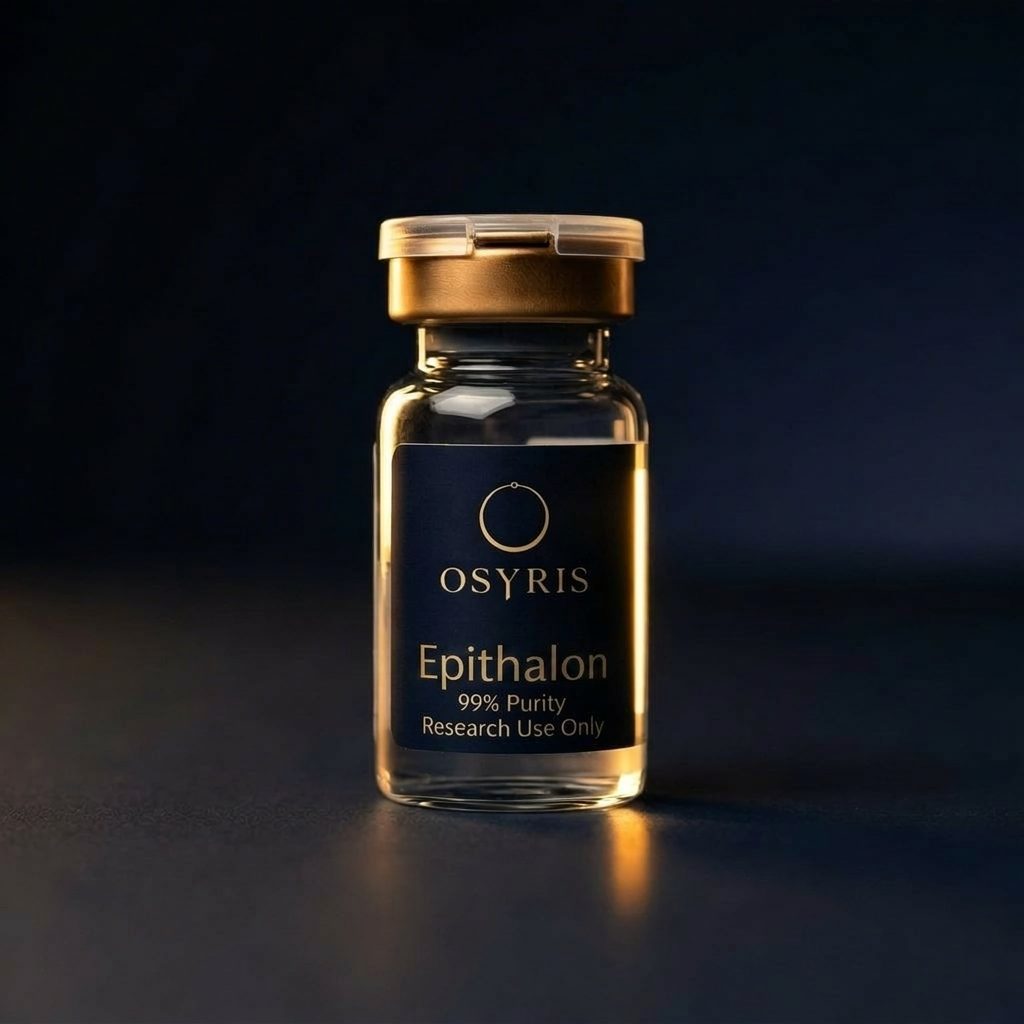
Epithalon research peptide vial — OSYRIS Health
LONGEVITY

Epithalon

$79.99

Epithalon (Ala-Glu-Asp-Gly) is a synthetic tetrapeptide modeled on pineal extracts. It is used in vitro and in vivo to investigate telomerase regulation, telomere dynamics, circadian biology, and molecular pathways associated with cellular aging and stress responses.

QuantityStandard research vial
PuritySee COA
Free shipping on orders over $200
Download Certificate of Analysis
About This Compound

Product Overview

Epithalon (also written as Epitalon or Epithalone) is a synthetic tetrapeptide with the sequence Ala-Glu-Asp-Gly. It was developed by Professor Vladimir Khavinson at the St. Petersburg Institute of Bioregulation and Gerontology in Russia, based on research into epithalamin — a peptide extract derived from the pineal gland. Epithalon is the synthetic version of this extract, designed to be a reproducible and standardized research tool.

The compound's primary research interest centers on its reported ability to activate telomerase — the enzyme that maintains telomere length at the ends of chromosomes. Telomere shortening is one of the hallmarks of cellular aging, and the relationship between telomere length, telomerase activity, and biological age has been a major focus of gerontology research for over two decades.

Epithalon is the most longevity-specific compound in the OSYRIS catalog. While other compounds in the Longevity category (NAD+, MOTS-C) are studied for broad cellular health effects, Epithalon research focuses specifically on the telomere maintenance mechanism.

Epithalon telomere and telomerase activation research visualization — OSYRIS Health
Research Applications

Mechanism and Experimental Context

Epithalon's most-cited research application is telomerase activation. Telomerase is a reverse transcriptase enzyme that adds nucleotide sequences to the ends of chromosomes (telomeres), counteracting the shortening that occurs with each cell division. In most somatic cells, telomerase activity is low or absent, meaning telomeres progressively shorten with age — a process linked to cellular senescence and age-related functional decline.1

Research by Khavinson's group demonstrated that Epithalon treatment reactivated telomerase in human somatic cell cultures that had low or no baseline telomerase activity. A 2003 study in the Bulletin of Experimental Biology and Medicine showed that Epithalon induced telomerase activity in human fetal fibroblast cultures and in pulmonary fibroblast cell lines, extending the number of cell doublings before senescence.2

It is important to note that the majority of Epithalon telomerase research has been conducted by Khavinson's laboratory group. While the findings are published in peer-reviewed journals, independent replication by other research groups is limited, which is a consideration when evaluating the evidence base.

Epithalon was originally developed as a synthetic analog of epithalamin, a pineal gland extract. Consequently, a significant body of research has investigated its effects on pineal gland function, particularly melatonin production. Melatonin is a hormone produced by the pineal gland that regulates circadian rhythm (the sleep-wake cycle) and functions as an antioxidant.3

Animal studies have shown that Epithalon administration increased melatonin production in aged rats, potentially restoring age-related declines in melatonin synthesis. This research is relevant because melatonin production decreases significantly with age in both humans and animal models, and reduced melatonin is associated with disrupted sleep patterns, reduced antioxidant capacity, and altered immune function in aging organisms.

Several longitudinal studies in animal models have investigated Epithalon's effects on lifespan and age-related parameters. Research in aging rats and mice showed that Epithalon treatment was associated with improvements in multiple biomarkers of aging, including reduced incidence of spontaneous tumors, improved immune function parameters, and normalized circadian rhythm disruption in aged animals.4

A notable series of studies by Anisimov et al. investigated Epithalon in cancer-prone mouse strains and reported that treatment was associated with reduced spontaneous tumor incidence and increased mean lifespan. However, these studies were conducted primarily in a single research program, and the tumor biology of the specific mouse strains used may limit generalizability.5

Epithalon has been studied for its effects on the neuroendocrine system — the network of glands and hormones that regulate body function. Research in aged rats demonstrated that Epithalon treatment normalized age-related changes in reproductive hormone levels and adrenal cortex function. These findings are interpreted in the context of Epithalon's effects on the pineal gland, which serves as a master regulator that influences other endocrine systems through melatonin signaling.

The neuroendocrine research suggests that Epithalon's effects may extend beyond direct telomerase activation to include broader hormonal regulation mediated through the pineal-hypothalamic axis.

Referenced Studies

Source Literature

[1]

Blackburn EH. "Telomere states and cell fates." Nature, 2000. PubMed: PMID 11089968

[2]

Khavinson VK, et al. "Peptide regulation of telomerase activity and age-associated changes in human fetal cell cultures." Bulletin of Experimental Biology and Medicine, 2003. PubMed: PMID 14615105

[3]

Khavinson VK, et al. "Effects of epithalon on the pineal gland and melatonin secretion in rats." Neuroendocrinology Letters, 2001. PubMed: PMID 11524638

[4]

Khavinson VK. "Peptides and Ageing." Neuroendocrinology Letters, 2002. PubMed: PMID 12424562

[5]

Anisimov VN, et al. "Effect of Epithalon on biomarkers of aging, life span and spontaneous tumor incidence in female Swiss-derived SHR mice." Biogerontology, 2003. PubMed: PMID 14618027

Certificate of Analysis

Batch Documentation

Current published batch documentation is surfaced on-page whenever the provider exposes a public COA asset.

Epithalon certificate of analysis

Frequently Asked Questions

Questions About Epithalon

Epithalon is a synthetic tetrapeptide (four amino acids: Ala-Glu-Asp-Gly) developed by Russian gerontologist Professor Vladimir Khavinson. It is a synthetic version of epithalamin, a peptide extract from the pineal gland. It is studied primarily in the context of telomerase activation and aging biology.

Telomeres are protective structures at the ends of chromosomes — like the plastic tips on shoelaces. Every time a cell divides, telomeres get a little shorter. When they get too short, the cell can no longer divide and enters a state called senescence. This progressive shortening is considered one of the fundamental mechanisms of cellular aging.

Telomerase is an enzyme that adds nucleotide sequences back onto the ends of telomeres, counteracting the shortening that occurs with cell division. Most adult cells have very low telomerase activity, which is why telomeres shorten with age. Epithalon is studied for its reported ability to reactivate telomerase in somatic cells.

No. Epithalon is not approved by the FDA for any use. It is a research chemical sold exclusively for laboratory research purposes.

Epithalon was developed by Professor Vladimir Khavinson at the St. Petersburg Institute of Bioregulation and Gerontology in Russia. His research group has published extensively on Epithalon and related peptide bioregulators over several decades.

They target different mechanisms. NAD+ research focuses on sirtuin activation, DNA repair, and mitochondrial function — cellular energy and maintenance systems. Epithalon research focuses specifically on telomerase activation and telomere maintenance. They represent different approaches to studying cellular aging.

Store lyophilized Epithalon at 2-8°C for short-term use or -20°C for long-term storage. Protect from light. Once reconstituted, refrigerate and use within your research protocol's timeframe.

Every batch is independently tested using HPLC and LC-MS analysis. The Certificate of Analysis is downloadable on this page.

Every Batch Tested by an Independent Lab

We publish the Certificate of Analysis for every product. See our full testing process.

See Our Standards →

All products sold by OSYRIS Health are intended for laboratory research purposes only and are not for human or veterinary use. The information provided on this page describes published scientific research and does not constitute medical advice, diagnosis guidance, or a recommendation for any specific use. Always ensure compliance with local regulations.