
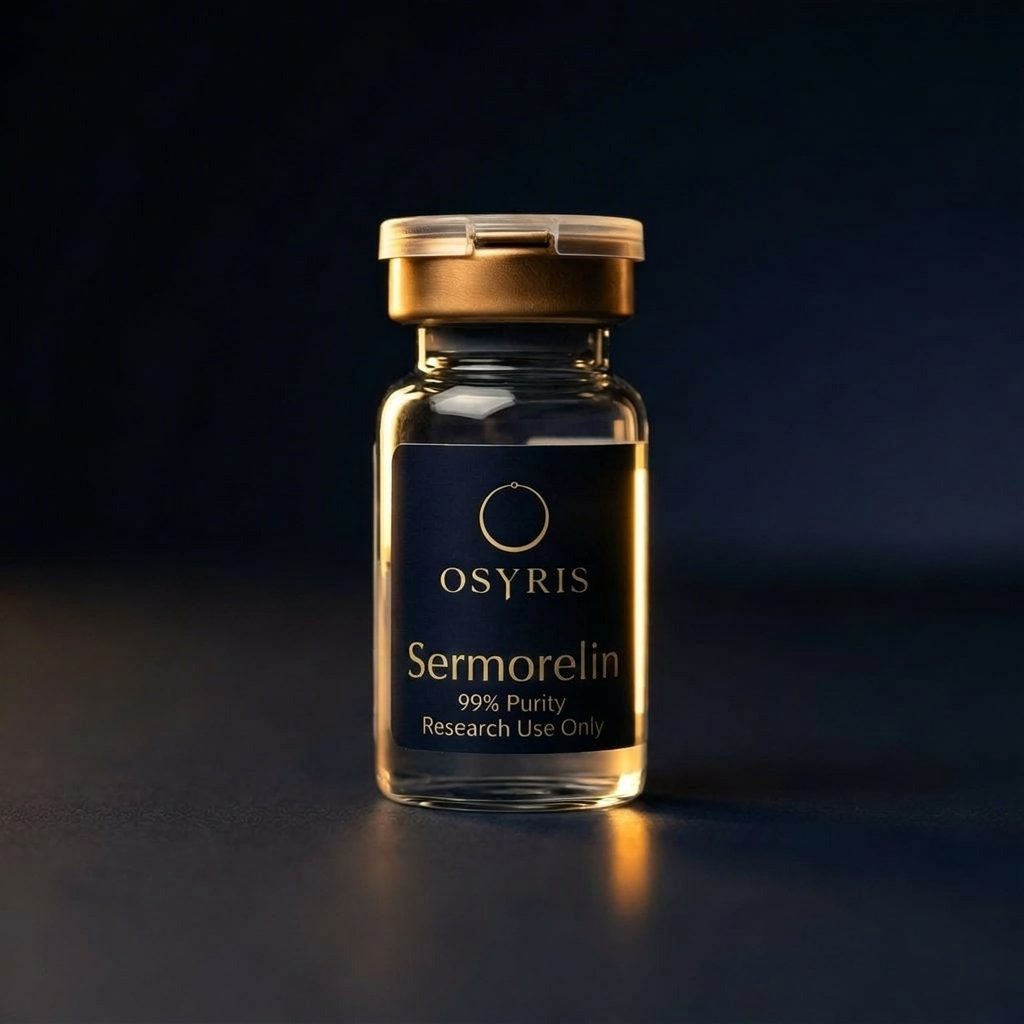
Sermorelin is the reference compound for studying GHRH receptor (GHRH-R) biology. It binds the GHRH-R on pituitary somatotroph cells and activates the cAMP signaling cascade that drives GH gene transcription and vesicle exocytosis. Because Sermorelin is the minimum active fragment of GHRH, it provides a clean pharmacological tool without the additional sequences present in full-length GHRH.1

Sermorelin
Sermorelin acetate (10mg) is a synthetic analog of growth hormone–releasing hormone (GHRH), consisting of the first 29 amino acids of the natural peptide. With ≥99% purity, this research peptide is used in laboratory studies exploring neuroendocrine regulation, aging models, and pituitary function. Supplied for research purposes only.
Product Overview
Sermorelin is a synthetic peptide consisting of the first 29 amino acids of the 44-amino-acid Growth Hormone Releasing Hormone (GHRH). It represents the minimum active fragment of GHRH — the portion that retains full receptor binding and biological activity. Sermorelin acts on the GHRH receptor in the anterior pituitary gland, stimulating the synthesis and pulsatile release of growth hormone.
Sermorelin has a notable clinical history: it was FDA-approved in the United States under the brand name Geref for the assessment of GH deficiency in children, though this approval has since been discontinued. This clinical history provides a more substantial safety and efficacy evidence base than most research peptides. Sermorelin is the oldest and most well-characterized GHRH analog in the OSYRIS Growth Hormone category.

Mechanism and Experimental Context
Sermorelin's former clinical use was as a diagnostic tool — a "GHRH stimulation test" that assessed pituitary capacity to produce GH. This application makes Sermorelin useful in research protocols that investigate pituitary function, GH reserve, and somatotroph responsiveness under various conditions.2
Sermorelin is compared with other GHRH analogs (Tesamorelin, CJC-1295) and with GHRPs (Ipamorelin) to study differences in GH release kinetics, amplitude, and duration. As the simplest GHRH analog, it serves as the baseline against which modified versions are evaluated.3
Keep the Research Trail Moving
Source Literature
Frohman LA, et al. "Rapid enzymatic degradation of growth hormone-releasing hormone by plasma in vitro and in vivo to a biologically inactive product cleaved at the NH2 terminus." Journal of Clinical Investigation, 1986. PubMed: PMID 3100581
Gelander L, et al. "Assessment of growth hormone secretion using Sermorelin." Hormone Research, 1995.
Alba-Roth J, et al. "Arginine stimulates growth hormone secretion by suppressing endogenous somatostatin secretion." Journal of Clinical Endocrinology & Metabolism, 1988.
Batch Documentation
Current published batch documentation is surfaced on-page whenever the provider exposes a public COA asset.

Frequently Asked Questions
Questions About Sermorelin
A synthetic peptide comprising the first 29 amino acids of GHRH. It stimulates the pituitary gland to produce and release growth hormone through the GHRH receptor.
Yes. Sermorelin (Geref) was FDA-approved for diagnostic assessment of GH deficiency in children. This approval has since been discontinued, but the clinical data from that era provides a substantial evidence base. OSYRIS Sermorelin is a research compound for laboratory use only.
Both are GHRH analogs targeting the same receptor. Tesamorelin has a trans-3-hexenoic acid modification that extends its half-life and was specifically studied in lipodystrophy models. Sermorelin is the simpler, shorter-acting version that more closely mimics natural GHRH kinetics.
Different receptors, different mechanisms. Sermorelin is a GHRH analog (acts on the GHRH receptor). Ipamorelin is a GHRP (acts on the ghrelin receptor). They stimulate GH through complementary pathways, which is why they're sometimes combined.
Growth Hormone Releasing Hormone — a 44-amino-acid hormone produced by the hypothalamus that signals the pituitary gland to produce and release growth hormone. Sermorelin is the biologically active fragment (amino acids 1-29).
Lyophilized at 2-8°C or -20°C. Protect from light.
Independently tested via HPLC and LC-MS. COA downloadable on this page.
Because GH biology involves multiple levels: GHRH analogs (Sermorelin, Tesamorelin) stimulate GH production, GHRPs (Ipamorelin) amplify release, combinations (CJC/Ipamorelin) target both pathways, IGF1-LR3 studies the downstream effector, and AOD-9604 isolates the fat-metabolism fragment. Each targets a different node in the somatotropic axis.
Every Batch Tested by an Independent Lab
We publish the Certificate of Analysis for every product. See our full testing process.