AboutStandards
About This Compound

Product Overview

VIP (Vasoactive Intestinal Peptide) is a 28-amino-acid neuropeptide originally discovered in the gut but now known to be widely distributed throughout the nervous system and immune organs. It was first isolated in 1970 by Sami Said and Viktor Mutt from porcine intestinal extracts. Despite its name, VIP's functions extend far beyond the vascular system — it is now recognized as a pleiotropic signaling molecule involved in immune regulation, neuroprotection, circadian rhythm, and smooth muscle relaxation.

VIP acts through two G-protein coupled receptors: VPAC1 and VPAC2. These receptors are expressed in immune cells, neurons, vascular smooth muscle, airway epithelium, and the gastrointestinal tract — explaining the breadth of VIP's biological effects. This wide receptor distribution makes VIP a versatile research tool for studying neuroimmune interactions.

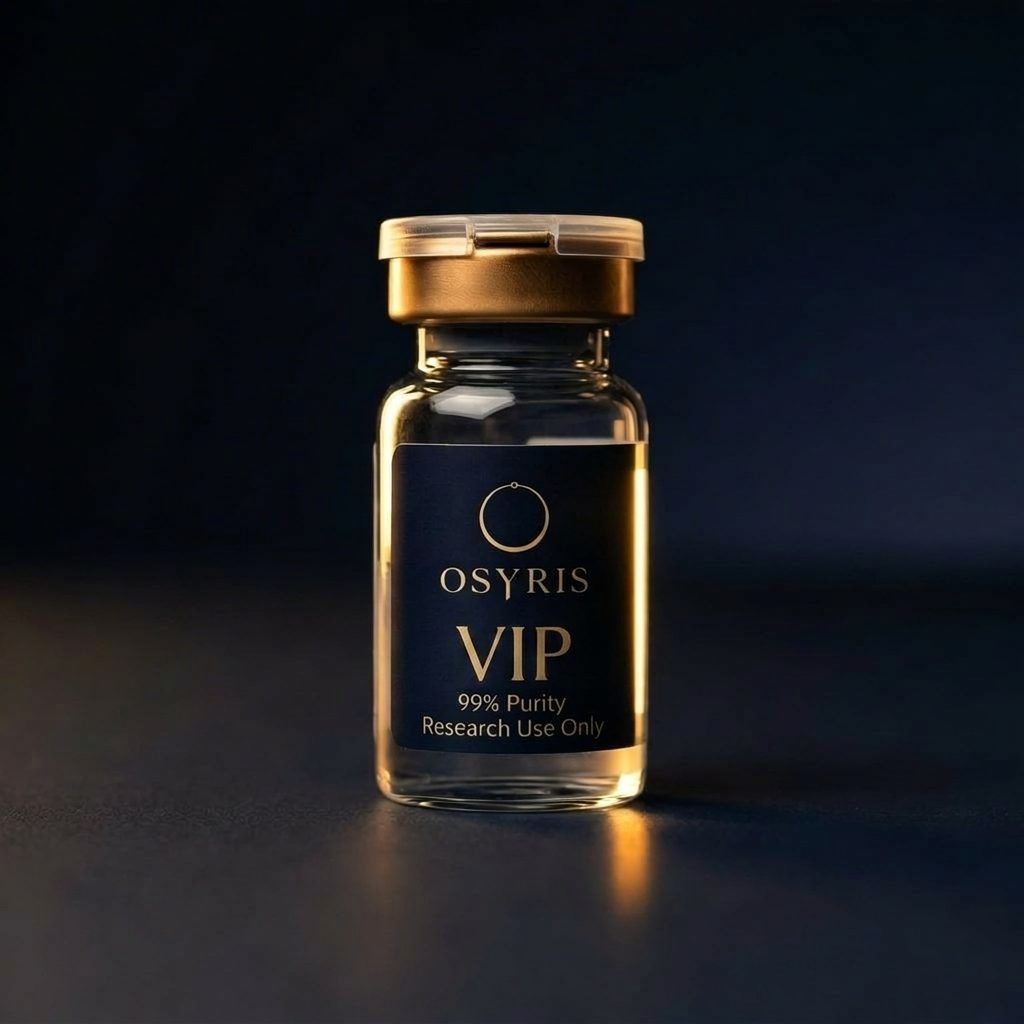
VIP neuroimmune signaling research visualization — OSYRIS Health
Research Applications

Mechanism and Experimental Context

VIP has been extensively studied for its anti-inflammatory effects. Research in animal models of autoimmune and inflammatory conditions has shown that VIP treatment reduces pro-inflammatory cytokine production (TNF-alpha, IL-6, IL-12), promotes anti-inflammatory cytokine secretion (IL-10), and modulates the balance between Th1 and Th2 immune responses.1

VIP functions as a neuropeptide in the central nervous system, where it plays roles in circadian rhythm regulation, neuroprotection, and synaptic transmission. Research in models of brain injury and neurodegeneration has demonstrated VIP's protective effects on neurons, potentially through VPAC receptor-mediated activation of survival signaling pathways.2

VIP's original discovery was in the context of vasodilation, and vascular biology remains an active research area. VIP relaxes smooth muscle in blood vessels, airways, and the GI tract through cAMP-mediated signaling via VPAC receptors.3

Referenced Studies

Source Literature

[1]

Delgado M, et al. "Vasoactive intestinal peptide: a neuropeptide with pleiotropic immune functions." Amino Acids, 2013. PubMed: PMID 22451275

[2]

Brenneman DE, et al. "VIP and activity-dependent neuroprotection." Annals of the New York Academy of Sciences, 2006.

[3]

Said SI. "Vasoactive intestinal peptide." Journal of Cardiovascular Pharmacology, 1984.

Certificate of Analysis

Batch Documentation

Current published batch documentation is surfaced on-page whenever the provider exposes a public COA asset.

VIP certificate of analysis

Frequently Asked Questions

Questions About VIP

Vasoactive Intestinal Peptide — a 28-amino-acid neuropeptide studied in immune regulation, neuroprotection, vascular biology, and circadian rhythm research.

Its anti-inflammatory and immune-modulatory effects are its most actively studied properties. VIP cross-lists to Cognitive (neuropeptide function) and Hormonal (reproductive biology research).

VPAC1 and VPAC2 — G-protein coupled receptors expressed on immune cells, neurons, smooth muscle, and epithelial tissue throughout the body.

Yes. VIP is produced by neurons throughout the central and peripheral nervous system, with high concentrations in the gut, brain, and immune organs.

No. OSYRIS VIP is a research compound sold exclusively for laboratory research.

Lyophilized at 2-8°C or -20°C. VIP is relatively sensitive to degradation — proper cold storage is important.

Independently tested via HPLC and LC-MS. COA downloadable on this page.

Different peptides, different mechanisms. VIP works through VPAC1/VPAC2 receptors. KPV works through direct NF-κB inhibition. Both have anti-inflammatory research applications but through entirely different pathways.

Every Batch Tested by an Independent Lab

We publish the Certificate of Analysis for every product. See our full testing process.

See Our Standards →

All products sold by OSYRIS Health are intended for laboratory research purposes only and are not for human or veterinary use. The information provided on this page describes published scientific research and does not constitute medical advice, diagnosis guidance, or a recommendation for any specific use. Always ensure compliance with local regulations.