

Hormonal
PT-141 — Melanocortin Signaling and the Central Nervous System
PT-141 (bremelanotide) melanocortin receptor research. MC3R/MC4R, CNS mechanism, energy homeostasis. PubMed citations.

A Different Kind of Receptor System
The melanocortin system is unusual in pharmacology. Unlike most receptor systems where one ligand acts on one receptor to produce one effect, the melanocortin system involves multiple endogenous ligands (α-MSH, β-MSH, γ-MSH, ACTH) acting on five receptor subtypes (MC1R-MC5R) distributed across the skin, brain, adrenal glands, immune cells, and exocrine glands. The result is a regulatory network that simultaneously influences pigmentation, appetite, sexual function, inflammation, and stress response.¹
PT-141 enters this complex system as a synthetic agonist with preferential activity at MC3R and MC4R — the subtypes expressed primarily in the central nervous system. This CNS selectivity is what distinguishes PT-141 from Melanotan 2 (which activates MC1R-MC5R non-selectively) and from the endogenous melanocortins (which have varying affinities across all five subtypes).
The CNS Mechanism
PT-141's most researched property — its effect on sexual function — operates entirely through central nervous system pathways. This distinguishes it from PDE5 inhibitors (sildenafil class), which act peripherally on vascular smooth muscle. PT-141 crosses the blood-brain barrier and activates MC4R in the hypothalamus, triggering downstream signaling through dopaminergic and oxytocinergic pathways.²
The central mechanism has been demonstrated in animal models by showing that PT-141's effects are blocked by MC4R antagonists and by dopamine receptor antagonists — confirming that the signaling cascade runs from melanocortin receptor to dopamine system to physiological response.
This distinction has research implications beyond sexual function. It means PT-141 is a tool for studying how central receptor activation influences peripheral physiological responses — a general pharmacological question relevant to many brain-body signaling systems.
MC4R and Energy Homeostasis
MC4R is one of the most studied receptors in energy homeostasis research. Loss-of-function mutations in the MC4R gene are the most common monogenic cause of severe obesity in humans, accounting for approximately 5-6% of severe childhood obesity cases. This genetic evidence established MC4R as a critical node in appetite and weight regulation.³
PT-141's activity at MC4R connects it to this metabolic biology. In animal models, MC4R agonism reduces food intake and increases energy expenditure. PT-141 produces these appetite-suppressive effects in rodent models, though it was not developed or optimized for this application.⁴
The MC4R-obesity connection has spurred development of MC4R-selective agonists like setmelanotide (Imcivree), which is FDA-approved for certain genetic obesity conditions. PT-141's broader MC3R/MC4R activity makes it a less selective but still useful tool for studying melanocortin-mediated metabolic regulation.
The Pharmaceutical Context
PT-141 occupies a unique regulatory position in the OSYRIS catalog. A pharmaceutical version (bremelanotide, branded as Vyleesi) received FDA approval in 2019 for a specific clinical indication — one of very few peptides in the catalog with an FDA-approved pharmaceutical equivalent.⁵
This clinical history provides two things the research community values: validated evidence that the compound produces measurable biological effects in humans (not just animal models), and published safety data from controlled clinical trials. While OSYRIS PT-141 is a research-grade compound sold exclusively for laboratory research, the pharmaceutical evidence base informs the design of preclinical research protocols.
Comparative Melanocortin Research
PT-141 is studied alongside other melanocortin agonists to map receptor-function relationships:
| Compound | Receptor Selectivity | Primary Research Application |
|---|---|---|
| α-MSH (endogenous) | MC1R-MC5R (broad) | Endogenous reference ligand |
| Melanotan 2 | MC1R-MC5R (non-selective) | Pigmentation + broad melanocortin |
| PT-141 | MC3R, MC4R (partially selective) | CNS-mediated behavior + metabolism |
| Setmelanotide | MC4R (highly selective) | Genetic obesity (clinical) |
| ACTH | MC2R (primary) | Adrenal function (endogenous) |
Using these compounds with different selectivity profiles allows researchers to delineate which effects are mediated by which receptor subtypes.
Featured Links
 Research Product
PT-141
Research Product
PT-141
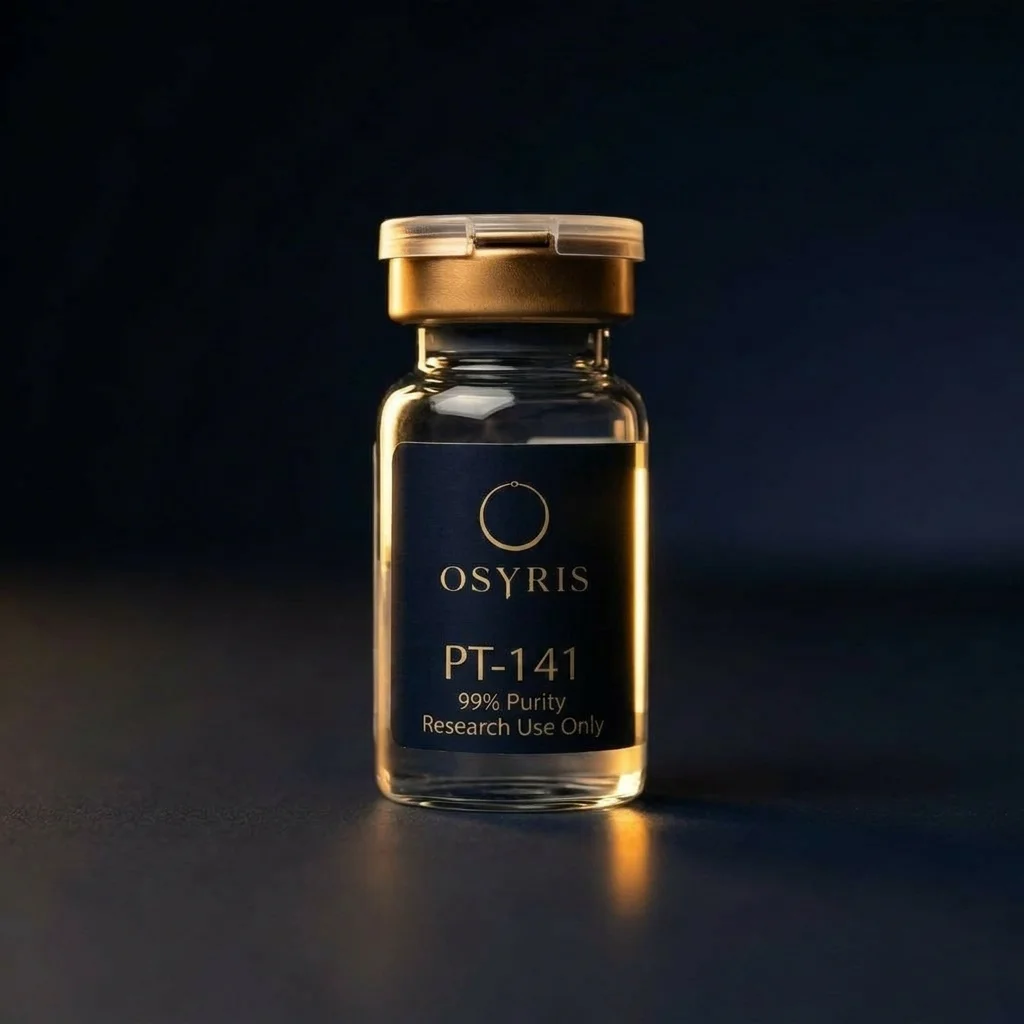
PT-141 (Bremelanotide) is a synthetic peptide analog derived from α-Melanocyte-Stimulating Hormone (α-MSH), consisting of seven amino acids. Supplied in lyophilized 10 mg vials for research use only, PT-141 is studied primarily for its interaction with melanocortin receptors and its role in central nervous system signaling pathways.
View product Research Product
Melanotan 2
Research Product
Melanotan 2
Melanotan II is a synthetic cyclic heptapeptide analog of α-MSH (alpha-melanocyte-stimulating hormone). It is studied for its interaction with melanocortin receptors, particularly MC1R and MC4R. MT-2 is used exclusively in laboratory settings to explore pigment regulation, energy homeostasis, and neuroendocrine signaling. Not for diagnostic or therapeutic use.
View product Research Product
Semax
Research Product
Semax
Semax is a synthetic heptapeptide (Met-Glu-His-Phe-Pro-Gly-Pro) derived from the ACTH(4–10) fragment of adrenocorticotropic hormone. It is widely used in neuroscience and pharmacological research for its ability to modulate brain-derived neurotrophic factor (BDNF), melanocortin receptors, and various neurotransmitter systems. Supplied as a lyophilized powder, Semax is intended strictly for laboratory research use only.
View productQuestions
Common Questions
How does PT-141 differ from Viagra/sildenafil?
Completely different mechanisms. PDE5 inhibitors act peripherally on blood vessel smooth muscle. PT-141 acts centrally through melanocortin receptors in the brain, triggering downstream dopaminergic signaling. Different target, different pathway, different pharmacology.
Is PT-141 FDA approved?
A pharmaceutical version (Vyleesi/bremelanotide) is FDA-approved. OSYRIS PT-141 is research-grade for laboratory use only.
What is MC4R's role in obesity?
MC4R loss-of-function mutations are the most common single-gene cause of severe obesity. The receptor is a critical node in appetite regulation, making MC4R agonists important research tools for energy homeostasis studies.
How is PT-141 different from Melanotan 2?
PT-141 was derived from MT-II but is more selective for MC3R/MC4R (brain receptors). MT-II activates MC1R-MC5R non-selectively, including MC1R (pigmentation). PT-141 has minimal MC1R activity.
Can PT-141 be used for metabolic research?
Yes. MC4R agonism reduces food intake and increases energy expenditure in animal models. While PT-141 wasn't developed for metabolic research, its MC4R activity makes it relevant to appetite and energy homeostasis studies.
What does "central mechanism" mean?
It means the compound acts in the brain (central nervous system) rather than in peripheral tissues. PT-141 crosses the blood-brain barrier and activates receptors in the hypothalamus.
References
- Hadley ME, Dorr RT. "Melanocortin peptide therapeutics." Peptides, 2006. PMID 16289303
- Pfaus JG, et al. "Melanocortins and sexual function." Current Topics in Behavioral Neurosciences, 2017. PMID 28730542
- Tao YX. "The melanocortin-4 receptor." Endocrine Reviews, 2010. PMID 20051527
- Wikberg JE, Mutulis F. "Targeting melanocortin receptors." Nature Reviews Drug Discovery, 2008. PMID 18323851
- Molinoff PB, et al. "PT-141: a melanocortin agonist." Annals of the New York Academy of Sciences, 2003. PMID 14960536