

AboutStandards
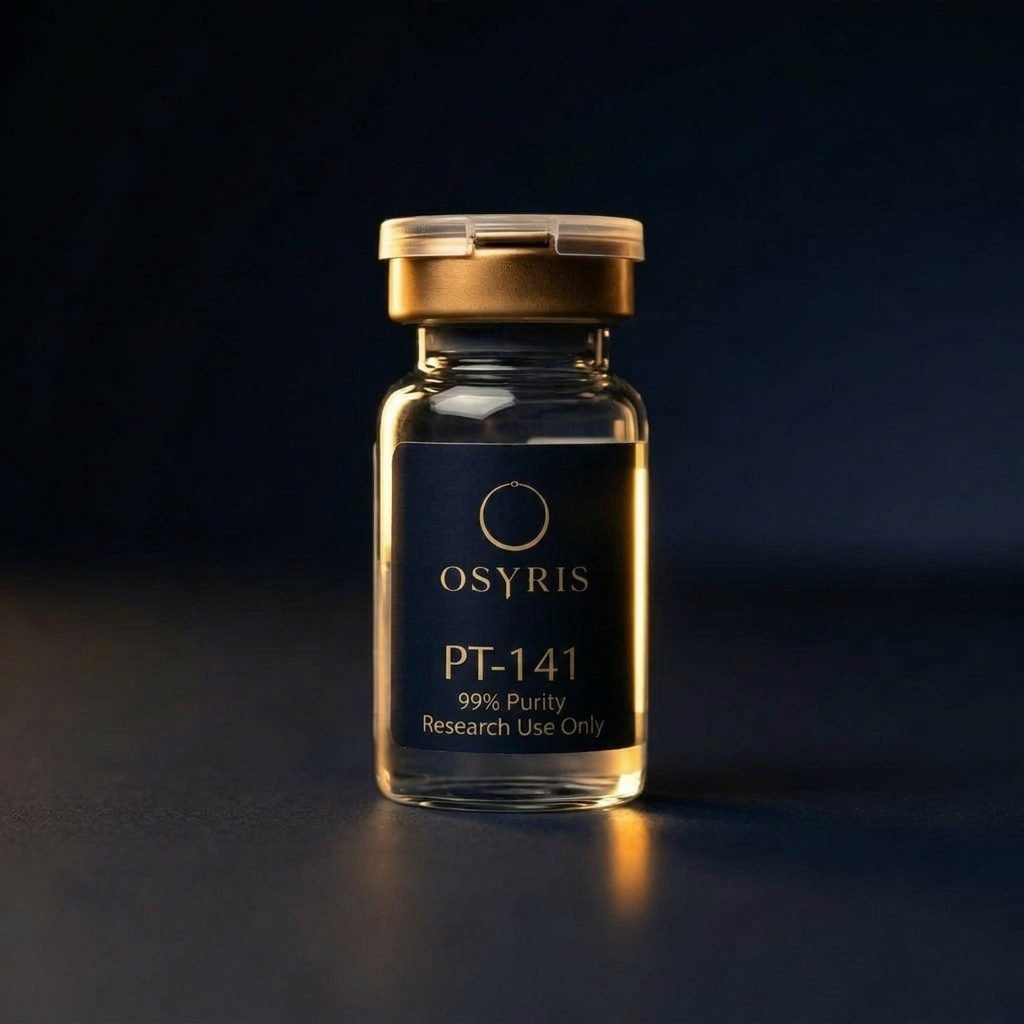
PT-141 research peptide vial — OSYRIS Health
HORMONAL

PT-141

$69.99

PT-141 (Bremelanotide) is a synthetic peptide analog derived from α-Melanocyte-Stimulating Hormone (α-MSH), consisting of seven amino acids. Supplied in lyophilized 10 mg vials for research use only, PT-141 is studied primarily for its interaction with melanocortin receptors and its role in central nervous system signaling pathways.

QuantityStandard research vial
PuritySee COA
Free shipping on orders over $200
Download Certificate of Analysis
About This Compound

Product Overview

PT-141, also known by its pharmaceutical name bremelanotide, is a synthetic cyclic heptapeptide that acts as a melanocortin receptor agonist. It was originally developed as a derivative of Melanotan II (MT-II) and is studied for its activity at melanocortin receptors — specifically MC3R and MC4R — which are expressed in the brain and involved in a range of physiological processes including sexual function, appetite regulation, energy homeostasis, and social behavior.

PT-141 is notable in the OSYRIS catalog for having the most advanced regulatory history of any product offered. An FDA-approved pharmaceutical version (branded as Vyleesi) exists as a prescription medication for a specific indication. However, OSYRIS PT-141 is a research-grade compound sold exclusively for laboratory research and is not a pharmaceutical product.

The compound has a molecular formula of C₅₀H₆₈N₁₄O₁₀ and a molecular weight of approximately 1025.2 g/mol.

PT-141 melanocortin receptor neural signaling research visualization — OSYRIS Health
Research Applications

Mechanism and Experimental Context

PT-141 acts primarily on melanocortin-3 (MC3R) and melanocortin-4 (MC4R) receptors in the central nervous system. Unlike phosphodiesterase inhibitors that act peripherally on vascular smooth muscle, PT-141 works through central nervous system pathways — a fundamentally different mechanism that has generated significant research interest.1

The melanocortin system is a group of peptide hormones and their receptors involved in diverse physiological functions. MC4R in particular is expressed in the hypothalamus and has been studied for its role in sexual function, appetite, energy balance, and social behavior. PT-141's selectivity for MC3R and MC4R makes it a useful pharmacological tool for studying melanocortin receptor biology.2

Because PT-141 crosses the blood-brain barrier and acts on central melanocortin receptors, it is studied in models of CNS-mediated physiological responses. Research in animal models has demonstrated that melanocortin receptor activation affects dopaminergic and oxytocinergic signaling pathways, which are involved in motivation, reward, and social behavior.3

This central mechanism of action distinguishes PT-141 from peripherally-acting compounds and makes it a tool for studying how central receptor signaling influences peripheral physiological responses.

MC4R, one of PT-141's primary targets, plays a well-documented role in energy homeostasis. Loss-of-function mutations in the MC4R gene are the most common monogenic cause of severe obesity in humans. Research in rodent models has demonstrated that MC4R agonism reduces food intake and increases energy expenditure, while MC4R antagonism produces the opposite effects.4

PT-141's activity at MC4R makes it a research tool for studying melanocortin-mediated appetite and energy regulation, though its broader receptor selectivity profile means its effects in these models reflect activation of multiple melanocortin receptor subtypes.

PT-141 is frequently studied alongside other melanocortin receptor agonists, including alpha-MSH (the endogenous ligand), Melanotan II (a less selective agonist), and setmelanotide (an MC4R-selective agonist approved for certain genetic obesity conditions). Comparative studies using these compounds help researchers map the functional roles of individual melanocortin receptor subtypes.5

Referenced Studies

Source Literature

[1]

Molinoff PB, et al. "PT-141: A melanocortin agonist for the treatment of sexual dysfunction." Annals of the New York Academy of Sciences, 2003. PubMed: PMID 14960536

[2]

Hadley ME, Dorr RT. "Melanocortin peptide therapeutics: historical milestones, clinical studies and commercialization." Peptides, 2006. PubMed: PMID 16289303

[3]

Pfaus JG, et al. "An overview of melanocortins and sexual function." Current Topics in Behavioral Neurosciences, 2017. PubMed: PMID 28730542

[4]

Tao YX. "The melanocortin-4 receptor: physiology, pharmacology, and pathophysiology." Endocrine Reviews, 2010. PubMed: PMID 20051527

[5]

Wikberg JE, Mutulis F. "Targeting melanocortin receptors: an approach to treat weight disorders and sexual dysfunction." Nature Reviews Drug Discovery, 2008. PubMed: PMID 18323851

Certificate of Analysis

Batch Documentation

Current published batch documentation is surfaced on-page whenever the provider exposes a public COA asset.

PT-141 certificate of analysis

Frequently Asked Questions

Questions About PT-141

PT-141 (bremelanotide) is a synthetic cyclic heptapeptide that acts as a melanocortin receptor agonist, primarily targeting MC3R and MC4R receptors in the central nervous system. It is sold by OSYRIS Health exclusively for laboratory research purposes.

A pharmaceutical version of bremelanotide (branded as Vyleesi) has received FDA approval as a prescription medication for a specific indication. OSYRIS PT-141 is a research-grade compound and is NOT a pharmaceutical product. It is sold exclusively for in vitro and preclinical research.

PT-141 was derived from Melanotan II but has a different receptor selectivity profile. Melanotan II is a less selective melanocortin agonist that acts on MC1R through MC5R. PT-141 is more selective for MC3R and MC4R. PT-141 also has a cyclic structure that gives it different pharmacokinetic properties.

Melanocortin receptors are a family of five G-protein coupled receptors (MC1R through MC5R) found throughout the body. They are activated by melanocortin peptide hormones and are involved in pigmentation (MC1R), adrenal function (MC2R), energy balance and sexual function (MC3R, MC4R), and exocrine gland function (MC5R).

No. PDE5 inhibitors act peripherally on vascular smooth muscle through the nitric oxide/cGMP pathway. PT-141 acts centrally through melanocortin receptors in the CNS. These are fundamentally different mechanisms, which is why researchers study PT-141 as an alternative pharmacological approach.

C₅₀H₆₈N₁₄O₁₀, with a molecular weight of approximately 1025.2 g/mol.

Store lyophilized PT-141 at 2-8°C, protected from light. Once reconstituted, refrigerate and use within your research protocol's designated timeframe.

Every batch is independently tested using HPLC and LC-MS analysis. The Certificate of Analysis is downloadable on this page.

Currently, yes. PT-141 is the only compound in the Sexual & Hormonal Health category. Additional compounds (Kisspeptin, HCG, Oxytocin) are planned for future catalog expansion.

MC4R, one of PT-141's primary targets, plays a well-documented role in appetite regulation and energy homeostasis. Loss-of-function mutations in the MC4R gene are the most common single-gene cause of severe obesity in humans. Researchers use melanocortin agonists like PT-141 to study this receptor system.

Every Batch Tested by an Independent Lab

We publish the Certificate of Analysis for every product. See our full testing process.

See Our Standards →

All products sold by OSYRIS Health are intended for laboratory research purposes only and are not for human or veterinary use. The information provided on this page describes published scientific research and does not constitute medical advice, diagnosis guidance, or a recommendation for any specific use. Always ensure compliance with local regulations.