

Hormonal
Hormonal Peptides — Melanocortin Signaling and Beyond
Guide to sexual and hormonal health research peptides. Melanocortin receptors, CNS mechanisms, MC4R biology. Current catalog and pipeline.
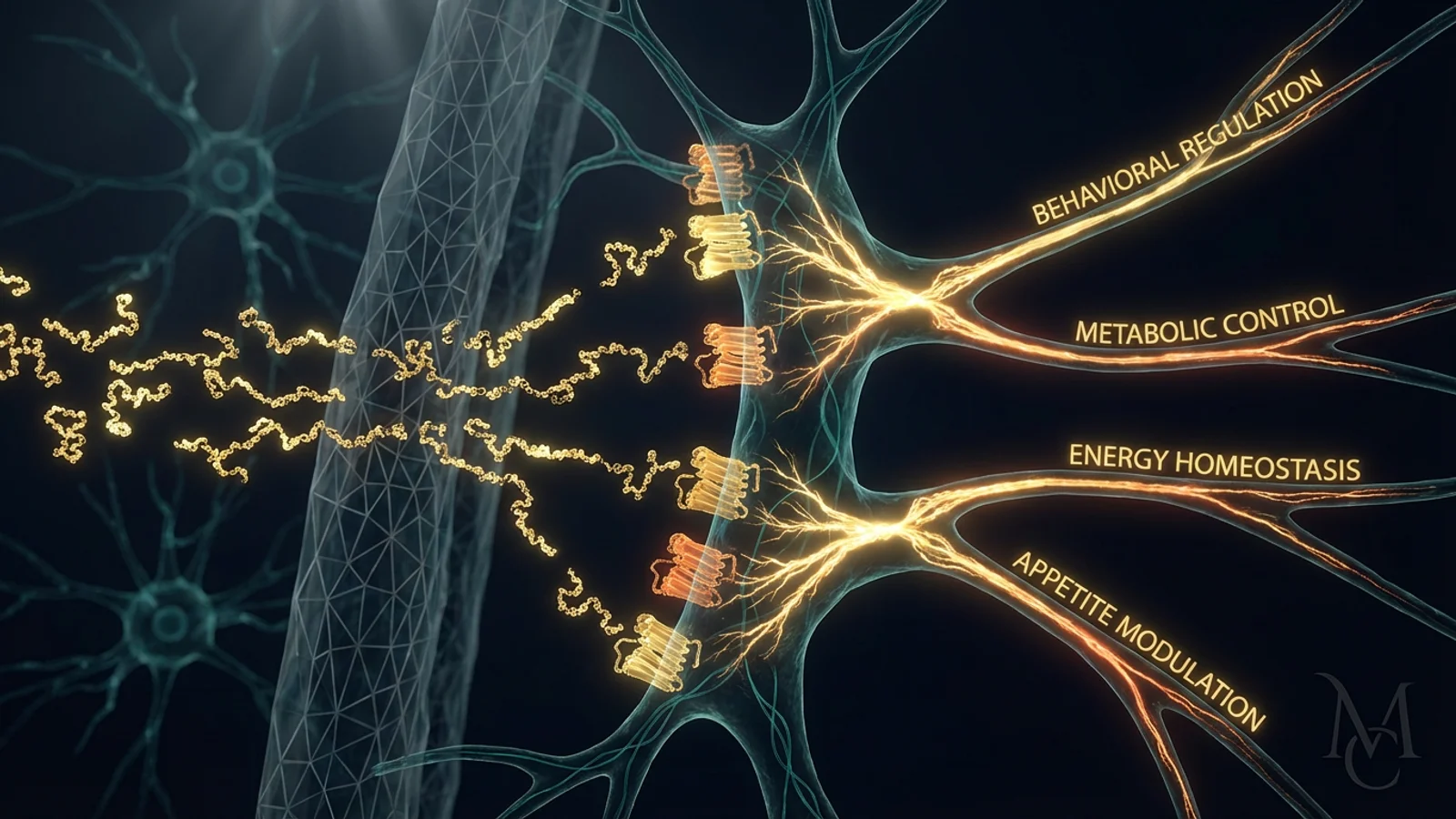
The Melanocortin System
The OSYRIS Hormonal category currently centers on melanocortin biology — one of the most functionally diverse receptor systems in human biology. Five receptor subtypes (MC1R-MC5R) are distributed across the skin, brain, adrenal glands, immune cells, and exocrine glands, mediating functions from pigmentation to appetite to sexual function to stress response.
PT-141 — the sole current product in this category — is a partially selective MC3R/MC4R agonist studied primarily for its central nervous system effects. Understanding PT-141 requires understanding the melanocortin system it acts on.
PT-141: The Only CNS-Mediated Approach
PT-141's mechanism is fundamentally different from peripheral approaches to the same research domain. While PDE5 inhibitors act on vascular smooth muscle (a peripheral target), PT-141 crosses the blood-brain barrier and activates melanocortin receptors in the hypothalamus, triggering downstream dopaminergic and oxytocinergic signaling.
This central mechanism has three research implications:
1. It acts through motivation/desire circuits rather than mechanical vascular pathways. This makes it a tool for studying CNS-mediated behavioral regulation.
2. It connects to MC4R energy homeostasis research. MC4R loss-of-function mutations cause severe obesity. PT-141's MC4R activity links it to appetite and metabolism research — not just sexual function.
3. It has an FDA-approved pharmaceutical equivalent (Vyleesi/bremelanotide), providing validated human pharmacological data that informs preclinical research design.
Category Expansion Pipeline
The Hormonal category is the smallest in the current OSYRIS catalog (one product). Future expansion compounds under consideration include:
- Kisspeptin — hypothalamic peptide that triggers GnRH release, studied in reproductive endocrinology
- HCG fragments — studied in reproductive biology models
- Oxytocin — neuropeptide studied in social behavior, bonding, and neuroendocrine research
These are not yet available. When launched, they will expand the Hormonal category beyond melanocortin biology into broader reproductive and social neuroendocrine research.
Researchers interested in being notified when new Hormonal compounds are added can sign up via the "Coming Soon" notification on the collection page.
Cross-Category Connections
PT-141's melanocortin biology connects to multiple research domains:
- Metabolic: MC4R agonism reduces food intake and increases energy expenditure (relevant to obesity research)
- Cognitive: MC3R/MC4R are expressed in the hippocampus and have been implicated in learning and memory models
- Immune: The melanocortin system has immunomodulatory functions (α-MSH is anti-inflammatory)
- Aesthetics: Melanotan 2 (same peptide family) targets MC1R for pigmentation research
Featured Links
Questions
Common Questions
Why is there only one product in this category?
The Hormonal category currently focuses on melanocortin-mediated research (PT-141). Additional compounds (Kisspeptin, HCG fragments, Oxytocin) are planned for future expansion.
How does PT-141 relate to Melanotan 2?
PT-141 was derived from MT-II. They share structural similarity but different receptor selectivity. MT-II is non-selective (MC1R-MC5R, used for pigmentation research). PT-141 is more selective (MC3R/MC4R, used for CNS-mediated research).
Can PT-141 be used for metabolic research?
Yes. MC4R agonism has well-documented effects on appetite and energy homeostasis. While PT-141 was developed for sexual function research, its MC4R activity makes it relevant to metabolic studies.
Is PT-141 FDA approved?
A pharmaceutical version (Vyleesi) is FDA-approved. OSYRIS PT-141 is research-grade for laboratory use only.
What is the melanocortin system?
A family of five G-protein coupled receptors (MC1R-MC5R) and their endogenous ligands (α-MSH, β-MSH, γ-MSH, ACTH). The system regulates pigmentation, appetite, sexual function, inflammation, and adrenal function.
When will new Hormonal compounds be available?
Future expansion compounds are under evaluation. Sign up for notifications on the collection page to be informed when new products launch.