

Guide
Understanding Peptide Purity Testing
How peptide purity testing works. HPLC, LC-MS, mass spectrometry, chromatograms, and what the numbers mean for your research.
Why Purity Testing Exists
When a peptide is synthesized, the final product is never 100% pure. Synthesis is a chemical process with inherent inefficiencies — incomplete couplings, side reactions, and residual reagents all contribute to impurities. The question is never "is this pure?" — it's "how pure is this, and are the impurities at levels that won't affect my research?"
Purity testing answers this question with analytical data rather than assumptions. Two complementary techniques form the standard: HPLC for purity and LC-MS for identity.
HPLC: Measuring Purity
What HPLC Does
HPLC stands for High-Performance Liquid Chromatography. It separates the components of a sample based on their chemical properties — how they interact with a stationary phase (the column) and a mobile phase (the solvent flowing through the column).
Here's the process in plain terms:
- A small amount of the peptide sample is dissolved and injected into the HPLC system
- A solvent (mobile phase) carries the sample through a packed column (stationary phase) at high pressure
- Different molecules interact with the column differently — some pass through quickly, others are retained longer
- As each component exits the column, a UV detector measures its absorbance
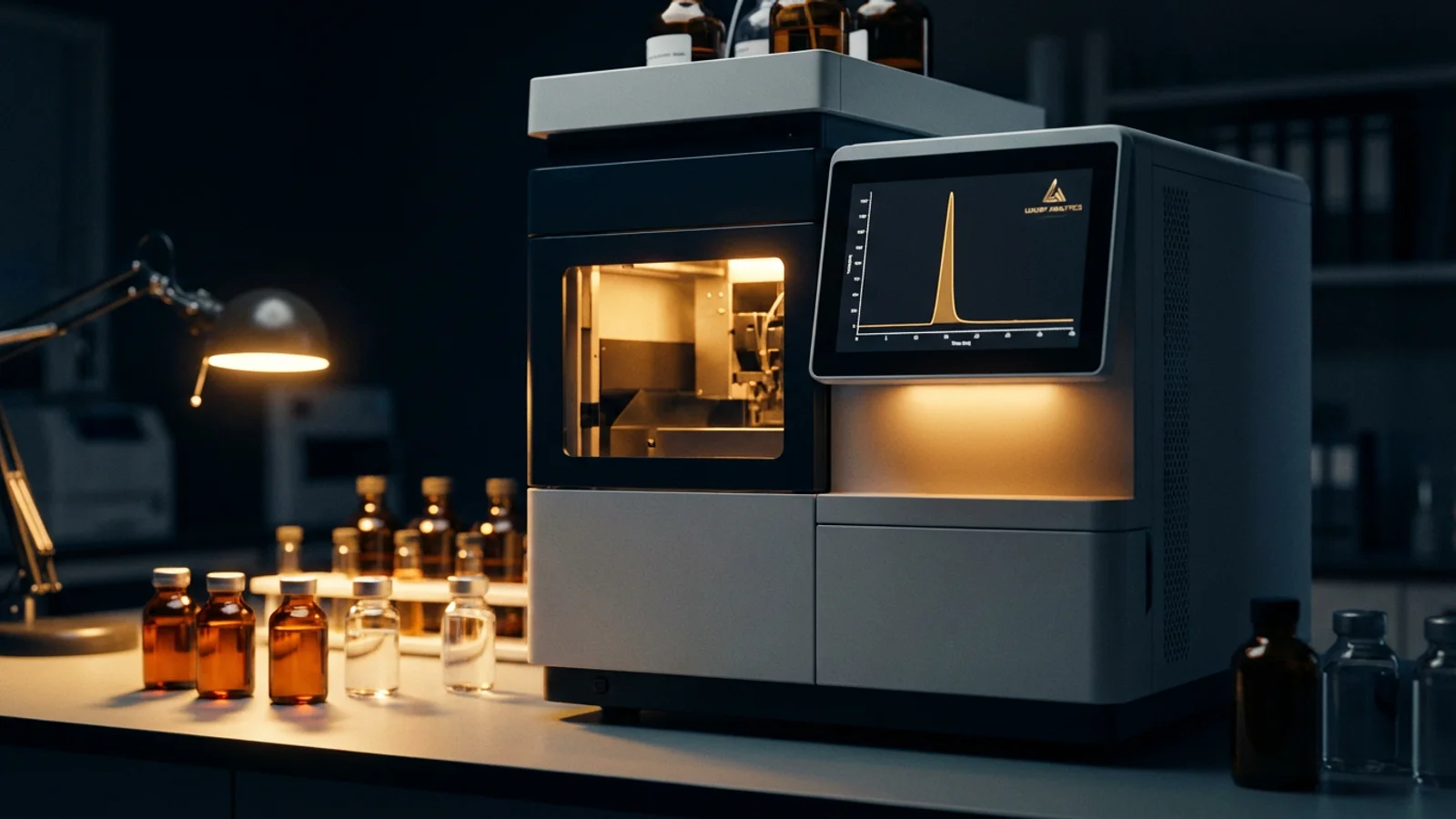
- The detector output is plotted as a chromatogram: signal intensity (y-axis) versus time (x-axis)
Each component appears as a peak at a specific retention time. The target peptide should appear as a single dominant peak. Impurities appear as smaller peaks at different retention times.
Reading a Chromatogram
The main peak: This is your target compound. It should be:
- Tall and sharp (indicating a concentrated, well-resolved compound)
- Symmetric (not tailing or fronting, which can indicate column issues or compound degradation)
- At the expected retention time for that compound under those conditions
The baseline: The flat line between peaks. A clean, flat baseline indicates good separation and low background noise. A noisy or rising baseline can obscure small impurity peaks.
Secondary peaks: Any peaks besides the main peak represent impurities. Their size relative to the main peak determines the purity calculation. Small peaks near the baseline are normal and expected. Large secondary peaks warrant investigation.
Purity calculation: The area under the main peak divided by the total area under all peaks, expressed as a percentage. If the main peak area is 99.2 and total peak area is 100.0, purity = 99.2%.
What HPLC Cannot Tell You
HPLC measures purity but not identity. A perfectly pure sample of the wrong compound would show a single peak at 100% purity — and the HPLC would not flag the error. This is why mass spectrometry is the essential complement to HPLC.
HPLC also cannot detect impurities that co-elute with the target compound (elute at exactly the same retention time). Different HPLC methods (different columns, solvents, gradients) can resolve co-eluting peaks that appear as a single peak under other conditions. This is why method selection matters and why purity numbers aren't directly comparable across different HPLC methods.
LC-MS: Confirming Identity
What LC-MS Does
LC-MS (Liquid Chromatography–Mass Spectrometry) combines HPLC separation with mass spectrometry detection. After the HPLC column separates the components, each component enters a mass spectrometer that measures its molecular weight (more precisely, its mass-to-charge ratio, m/z).
This solves the identity problem: the mass spectrometer confirms that the molecule exiting the column at the expected retention time has the correct molecular weight for your target peptide.
Reading Mass Spec Data
Expected vs Observed Molecular Weight:
- The COA reports the theoretical molecular weight (calculated from the amino acid sequence) and the observed molecular weight (measured by the instrument)
- A match within ±1-2 Da confirms identity
- Example: BPC-157 expected MW = 1419.53 Da, observed MW = 1419.51 Da — this is a positive identity confirmation
Mass Spectrum: The mass spectrum shows peaks at different m/z values. The dominant peak should correspond to the target compound. Common ionization states include [M+H]+ (molecular weight + 1 proton), [M+2H]2+ (doubly charged), and [M+Na]+ (sodium adduct). The COA should note which ionization state was observed so you can verify the calculation.
What LC-MS Cannot Tell You
LC-MS confirms molecular weight but not purity — a sample contaminated with 20% of a different compound would show two mass peaks, but the relative amounts are better quantified by HPLC. LC-MS also cannot distinguish between structural isomers that have the same molecular weight but different amino acid sequences or configurations (e.g., D-amino acid substitutions).
The Complete Picture: HPLC + LC-MS Together
Neither technique alone provides complete characterization. Together, they answer both essential questions:
| Question | Technique | What It Measures |
|---|---|---|
| Is this pure? | HPLC | Percentage of sample that is the target compound |
| Is this the right compound? | LC-MS | Molecular weight confirming molecular identity |
A credible COA should include results from both techniques. If a vendor provides only HPLC purity without mass spec confirmation, or mass spec without purity data, the characterization is incomplete.
Beyond the Basics: Additional Tests
Some research applications require additional characterization beyond standard HPLC + LC-MS:
Amino Acid Analysis (AAA): Hydrolyzes the peptide into individual amino acids and quantifies each. Confirms amino acid composition. The most definitive sequence verification short of Edman degradation or tandem MS sequencing.
Endotoxin Testing (LAL): Detects bacterial endotoxin contamination. Critical for cell culture and in vivo applications where endotoxins can activate immune responses and confound results.
Counterion Analysis: Identifies the salt form of the peptide (acetate, TFA, hydrochloride). The counterion affects peptide content calculations and may matter for certain research applications.
Circular Dichroism (CD): Measures secondary structure (alpha-helix, beta-sheet, random coil). Relevant for peptides where conformation affects activity.
These tests are not routinely included in standard COAs but may be available on request for specific research applications.
How OSYRIS Tests
Every batch of every OSYRIS product undergoes:
- HPLC purity analysis — confirming ≥98% purity (typical: 99.0-99.5%)
- LC-MS identity confirmation — confirming correct molecular weight within ±1-2 Da
- Third-party independent testing — performed by a laboratory with no financial relationship to OSYRIS or the manufacturer
Results are published as a downloadable COA on every product page. When a new batch is tested, the COA is updated.
Featured Links
Questions
Common Questions
What does HPLC stand for?
High-Performance Liquid Chromatography. It separates and quantifies the components of a sample to determine purity.
What does LC-MS stand for?
Liquid Chromatography–Mass Spectrometry. It combines HPLC separation with mass spectrometric identification to confirm both purity and molecular identity.
Why are both tests needed?
HPLC measures purity but not identity. LC-MS confirms identity but doesn't precisely quantify purity. Together, they answer "is it pure?" and "is it the right compound?"
What's a good purity for research peptides?
≥98% is the standard for research-grade. Higher purity (≥99%) may be needed for sensitive assays. OSYRIS guarantees ≥98% with typical results of 99.0-99.5%.
Can I compare purity between different vendors?
Only if the HPLC methods are comparable. Different columns, solvents, and gradients can resolve or obscure impurities differently. The chromatogram itself tells you more than the number alone.
What is TFA and why does it appear on COAs?
TFA (trifluoroacetic acid) is a common counterion used during peptide synthesis and HPLC purification. It may be noted on the COA as the salt form. TFA doesn't indicate impurity — it's part of the standard manufacturing process.
What is peptide content vs purity?
Purity (HPLC) measures what fraction of the sample is the target compound vs impurities. Peptide content measures what fraction of the total powder weight is peptide vs salts, water, and counterions. Both are legitimate measures — they answer different questions.
How does OSYRIS ensure testing independence?
All testing is performed by a third-party analytical laboratory with no ownership, financial, or operational relationship to OSYRIS or the compound manufacturer. The laboratory's sole role is to analyze the sample and report results.