

Guide
How to Read a Certificate of Analysis
Learn how to read a Certificate of Analysis for research peptides. HPLC chromatograms, purity data, molecular weight, batch numbers explained.
Why COAs Matter
A Certificate of Analysis is the single most important document in peptide research. It answers two questions that every researcher needs answered before using any compound: Is this actually the compound it claims to be? And how pure is it?
Without a COA, you're trusting a label. With a COA, you're trusting analytical data from an independent laboratory. The difference matters — especially when your research results depend on the identity and purity of the materials you're using.
This guide walks through every section of a typical peptide COA, explains what the data means, and shows you what to look for (and what to watch out for).
The Anatomy of a COA
A standard peptide COA contains five core elements. Some COAs include additional information, but these five are the minimum you should expect:
1. Product Identification
The top of the COA identifies what was tested:
Product Name — The compound name (e.g., BPC-157, Semax, GHK-Cu). This should match your order exactly.
Batch/Lot Number — A unique identifier for this specific production batch. Every vial produced from the same synthesis run shares the same batch number and the same COA. If you order the same product a month later, you may receive a different batch with a slightly different COA — this is normal.
Catalog/SKU Number — The vendor's internal product identifier.
Quantity Tested — How much material was submitted for analysis. This is usually expressed in milligrams.
Date of Analysis — When the testing was performed. For lyophilized peptides stored properly, test results remain valid for the shelf life of the product. A COA from 3 months ago for a product with a 12-month shelf life is perfectly acceptable.
2. Purity (HPLC)
This is the number most researchers look at first. Purity is expressed as a percentage and represents how much of the sample is the target compound versus impurities.
What the number means:
- 99.2% purity = 99.2% of the sample is your target compound. 0.8% is other material.
- OSYRIS standard: ≥98% guaranteed. Typical results: 99.0-99.5%.
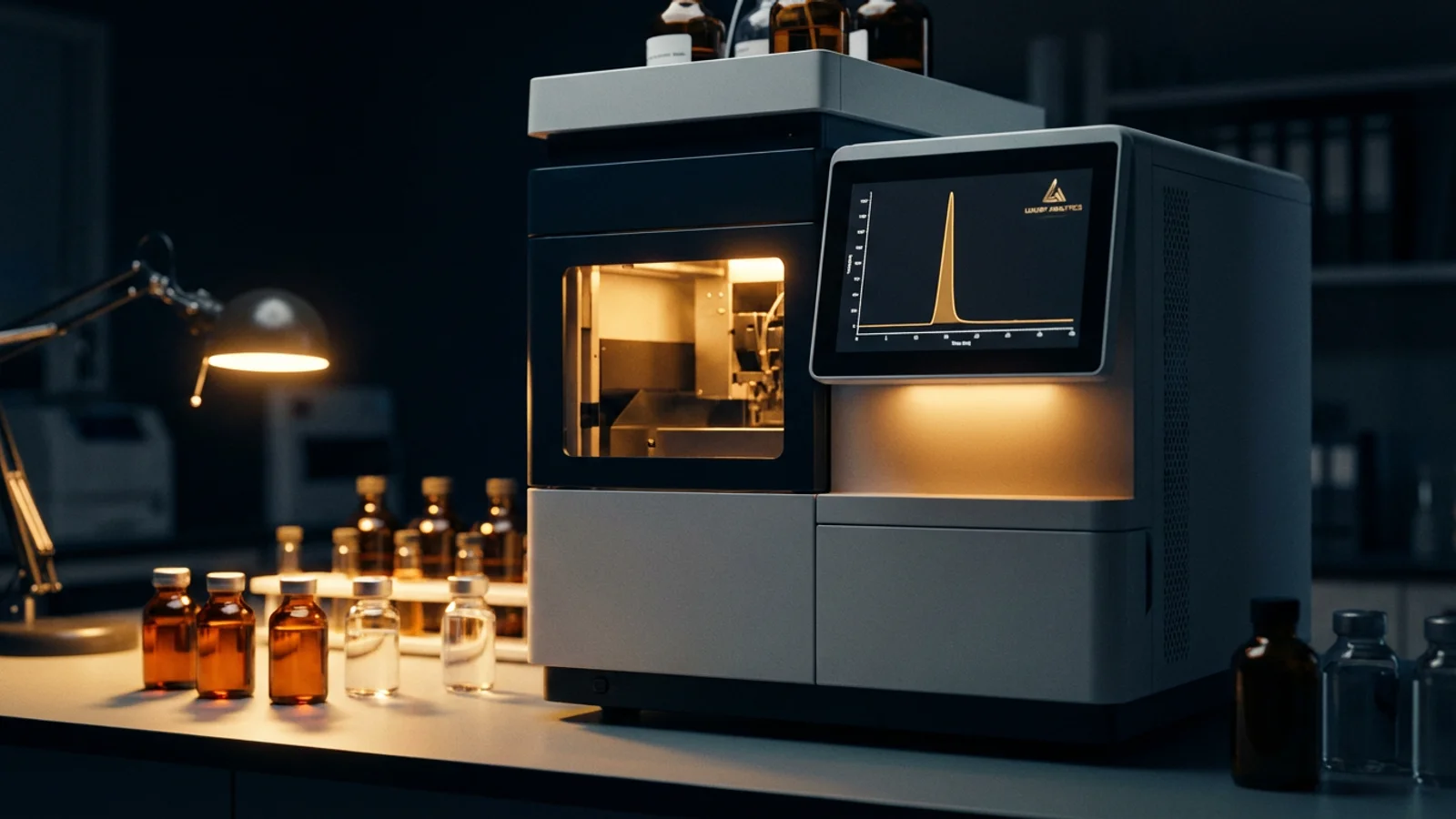
How it's measured: HPLC (High-Performance Liquid Chromatography) separates the sample's components by passing it through a column at high pressure. Different molecules move through the column at different speeds based on their size, charge, and chemical properties. The detector records a signal as each component exits the column, producing a chromatogram — a graph of signal intensity versus time.
The target compound appears as the dominant peak. Impurities appear as smaller peaks at different retention times. Purity is calculated as:
`Purity (%) = (Area of main peak / Total area of all peaks) × 100`
What to look for:
- Purity ≥98% is the standard for research-grade peptides
- A single sharp, symmetric main peak indicates a clean synthesis
- Multiple significant secondary peaks suggest impurities that may affect research results
- The retention time of the main peak should be consistent with the known retention time for that compound under those HPLC conditions
Red flags:
- Purity below 95% without explanation
- No chromatogram included (just a number without the supporting graph)
- Multiple peaks of similar size (suggests a mixture rather than a pure compound)
- No retention time reported
3. Molecular Weight Confirmation (Mass Spectrometry)
Mass spectrometry (usually LC-MS or MALDI-TOF) measures the molecular weight of the compound and compares it to the theoretical value.
What the data shows:
- Expected MW: The calculated molecular weight based on the amino acid sequence (e.g., BPC-157: 1419.53 g/mol)
- Observed MW: The molecular weight measured by the mass spectrometer
- A match within instrument tolerance (typically ±1-2 Da) confirms compound identity
Why this matters: Purity alone doesn't confirm identity. A sample could be 99% pure — but 99% pure of the wrong compound. Mass spec confirmation ensures the molecule in the vial actually has the correct molecular structure. HPLC tells you it's pure. Mass spec tells you it's the right thing.
What to look for:
- Observed MW within ±1-2 Da of expected MW
- A clean mass spectrum with a dominant peak at the expected m/z value
- The ionization state noted (e.g., [M+H]+, [M+2H]2+) so you can verify the calculation
Red flags:
- Observed MW off by more than 3 Da (may indicate a different compound, truncation, or modification)
- No mass spec data at all (HPLC purity without identity confirmation is insufficient)
- Multiple dominant mass peaks (suggests a mixture)
4. Appearance and Physical Description
Many COAs include a visual description of the product:
- Appearance: "White to off-white lyophilized powder" (typical for most peptides)
- Solubility: Notes on solubility in common solvents (water, DMSO, acetic acid)
This section is less critical than purity and identity but can flag problems if the description doesn't match what you received (e.g., a COA says "white powder" but you received a yellow or brown product).
5. Additional Tests (When Present)
Some COAs include additional characterization:
Amino Acid Analysis (AAA): Breaks down the peptide into individual amino acids and quantifies each. Confirms the amino acid composition matches the expected sequence. This is the gold standard for sequence verification but is not always included.
Endotoxin Testing (LAL): Measures bacterial endotoxin contamination. Important for research involving cell culture or in vivo models where endotoxins could confound results. Reported as EU/mg (endotoxin units per milligram). Research-grade peptides typically should be <5 EU/mg.
Water Content (Karl Fischer): Measures residual moisture in lyophilized products. High water content can accelerate degradation. Typical acceptable range: <8%.
Peptide Content: The percentage of the lyophilized powder that is actual peptide (vs. counter-ions, salts, and residual moisture). Peptide content of 80% means that in a vial labeled "10mg," approximately 8mg is active peptide and 2mg is salt/water. This is normal and industry-standard — peptide content below 100% doesn't mean low quality.
COAs You Should Question
Not all COAs are equal. Here are patterns that should raise concern:
"In-house testing only." If the vendor tested their own product with no independent verification, the COA has an inherent conflict of interest. Independent third-party testing is the standard.
Generic COAs. If the same COA appears to cover multiple batches, or if the document looks like a template with numbers filled in rather than an actual analytical report, it may not represent real testing.
No chromatogram. A purity number without the supporting HPLC chromatogram is unverifiable. The chromatogram is the raw data — it should always be included.
No mass spec. Purity without identity confirmation is incomplete. You know it's pure, but pure what?
Outdated testing. A COA from 2+ years ago for a product currently being sold may not reflect the current batch. Ask for the COA specific to the batch you're purchasing.
Round numbers. Real analytical results have decimal precision (99.23%, 1419.51 Da). Perfectly round numbers (99.0%, 1420.0) can indicate estimated or fabricated data, though this is not always the case.
How OSYRIS Handles COAs
Every OSYRIS product page includes a downloadable COA for the current batch. When a new batch is produced and tested, the COA on the product page is updated to reflect the new batch's results. If you need the COA for a specific batch you purchased previously, contact support with your order number.
Our COAs include:
- Batch/lot number
- HPLC purity percentage with chromatogram
- LC-MS molecular weight confirmation with mass spectrum
- Date of analysis
- Third-party laboratory identification
We publish real analytical data. We do not use template COAs, in-house testing, or manufacturer-provided results without independent verification.
A Note on "Perfect" Results
It's worth mentioning that very high purity numbers (99.8%, 99.9%) should be evaluated in context. HPLC purity depends on the method conditions — column type, mobile phase, gradient, detection wavelength. A peptide that shows 99.9% purity under one set of HPLC conditions might show 99.2% under more stringent conditions that resolve closely-eluting impurities.
This doesn't mean high purity numbers are wrong. It means that purity comparisons between vendors are only meaningful if the HPLC methods are comparable. The chromatogram itself — the shape of the peaks, the resolution between peaks, the baseline quality — tells you more than the number alone.
Featured Links
Questions
Common Questions
What is a Certificate of Analysis?
A document reporting the results of analytical testing performed on a specific batch of a compound. It typically includes purity data (HPLC), identity confirmation (mass spectrometry), batch number, and date of analysis.
What purity should I look for?
Research-grade peptides should be ≥98% purity. OSYRIS guarantees this minimum and typically delivers 99.0-99.5%. Purity requirements may vary depending on the sensitivity of your research application.
What's the difference between HPLC purity and peptide content?
HPLC purity measures what percentage of the sample is your target compound vs impurities. Peptide content measures what percentage of the lyophilized powder is peptide vs salts, counter-ions, and residual water. A product can be 99% HPLC pure with 80% peptide content — both numbers are normal.
Why does mass spec matter if purity is high?
Purity tells you the sample is clean. Mass spec tells you it's the right compound. A sample could be 99% pure — of the wrong molecule. Both tests are needed for complete characterization.
How often are COAs updated?
OSYRIS updates the COA on each product page whenever a new batch is produced and tested. Each COA corresponds to a specific batch/lot number.
Should I trust a COA without a chromatogram?
A purity number without the supporting HPLC chromatogram is unverifiable. The chromatogram is the raw data. Any credible COA should include it.
What does "third-party testing" mean?
Testing performed by an independent laboratory that has no financial relationship with the compound's manufacturer or vendor. Third-party testing eliminates the conflict of interest inherent in self-testing.
Can I request the COA for my specific batch?
Yes. Every OSYRIS order ships product from a specific tested batch. The COA on the product page corresponds to the current batch. If you need a COA for a previous batch, contact support with your order number.
References
- United States Pharmacopeia. "General Chapter <621> Chromatography." USP Reference Standards.
- ICH Harmonised Guideline Q2(R2). "Validation of Analytical Procedures." International Council for Harmonisation, 2022.